Description

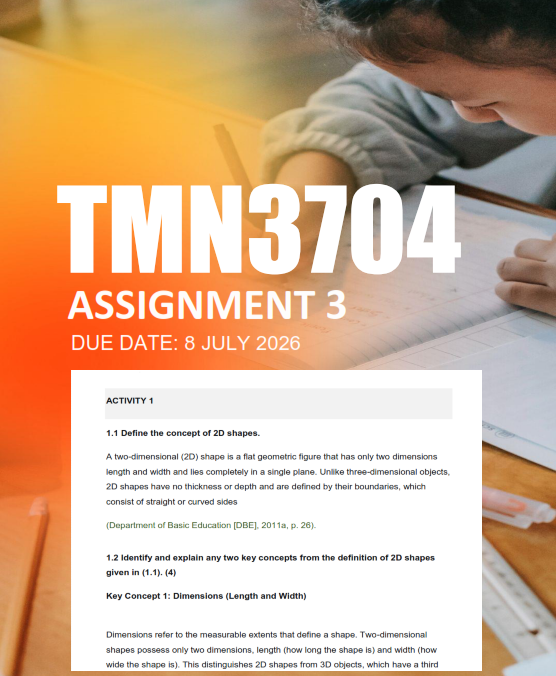
TMN3704 ASSIGNMENT 3 2026
DUE 8 JULY 2026

ACTIVITY 1
1.1 Define the concept of 2D shapes.
A two-dimensional (2D) shape is a flat geometric figure that has only two dimensions
length and width and lies completely in a single plane. Unlike three-dimensional objects,
2D shapes have no thickness or depth and are defined by their boundaries, which
consist of straight or curved sides
(Department of Basic Education [DBE], 2011a, p. 26).
1.2 Identify and explain any two key concepts from the definition of 2D shapes
given in (1.1). (4)
Key Concept 1: Dimensions (Length and Width)

Dimensions refer to the measurable extents that define a shape. Two-dimensional
shapes possess only two dimensions, length (how long the shape is) and width (how
wide the shape is). This distinguishes 2D shapes from 3D objects, which have a third
dimension, depth or height. For example, a rectangle drawn on paper has length and
width but no physical thickness
(TMN3704 Study Guide, 2024, p. 32).


Reviews

There are no reviews yet.

Be the first to review “TMN3704 Assignment 3 Semester 1 2026 – Due 8 July 2026”

Your email address will not be published. Required fields are marked *

Description

TMN3704 ASSIGNMENT 3 2026
DUE 8 JULY 2026

ACTIVITY 1
1.1 Define the concept of 2D shapes.
A two-dimensional (2D) shape is a flat geometric figure that has only two dimensions
length and width and lies completely in a single plane. Unlike three-dimensional objects,
2D shapes have no thickness or depth and are defined by their boundaries, which
consist of straight or curved sides
(Department of Basic Education [DBE], 2011a, p. 26).
1.2 Identify and explain any two key concepts from the definition of 2D shapes
given in (1.1). (4)
Key Concept 1: Dimensions (Length and Width)

Dimensions refer to the measurable extents that define a shape. Two-dimensional
shapes possess only two dimensions, length (how long the shape is) and width (how
wide the shape is). This distinguishes 2D shapes from 3D objects, which have a third
dimension, depth or height. For example, a rectangle drawn on paper has length and
width but no physical thickness
(TMN3704 Study Guide, 2024, p. 32).

Reviews

There are no reviews yet.

Be the first to review “TMN3704 Assignment 3 Semester 1 2026 – Due 8 July 2026”

Your email address will not be published. Required fields are marked *

About this TMN3704 resource

This downloadable Assignment Study Resource is listed for the UNISA module TMN3704. Review the document title, description, seller information, price and learner reviews before purchasing to make sure it matches your current module requirements.

StudyPass helps distance-learning students search by module code and discover notes, revision material and study resources shared by independent sellers. Always compare the resource details with your latest official UNISA tutorial letters and assessment instructions.

Search for another UNISA module code or visit the UNISA Study Hub for practical distance-learning and exam-preparation tips.

0
0
Your Shopping Cart
Your cart is emptyReturn to Shop