Description

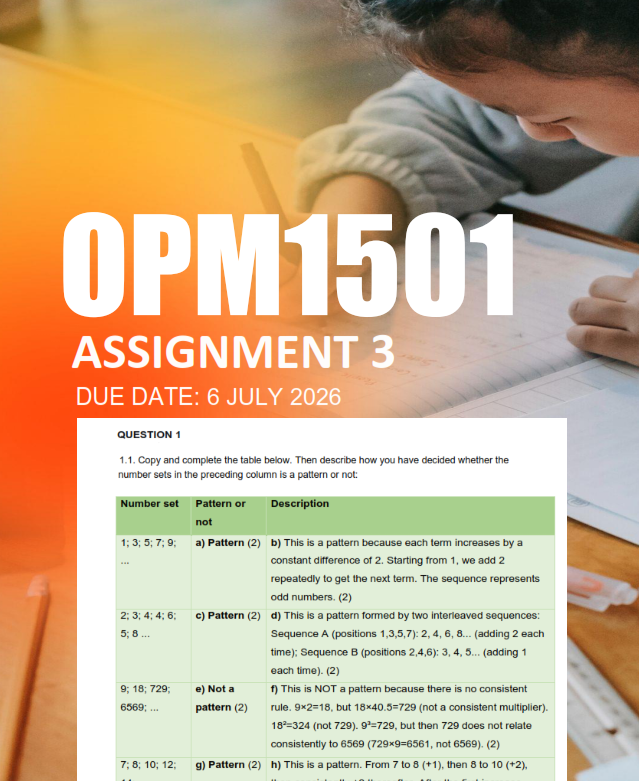
OPM1501 ASSIGNMENT 3 2026
DUE 6 JULY 2026
QUESTION 1

1.1. Copy and complete the table below. Then describe how you have decided whether the
number sets in the preceding column is a pattern or not:
Number set Pattern or
not
Description
1; 3; 5; 7; 9;

a) Pattern (2) b) This is a pattern because each term increases by a
constant difference of 2. Starting from 1, we add 2
repeatedly to get the next term. The sequence represents
odd numbers. (2)
2; 3; 4; 4; 6;
5; 8 …
c) Pattern (2) d) This is a pattern formed by two interleaved sequences:
Sequence A (positions 1,3,5,7): 2, 4, 6, 8… (adding 2 each
time); Sequence B (positions 2,4,6): 3, 4, 5… (adding 1
each time). (2)
9; 18; 729;
6569; …
e) Not a
pattern (2)
f) This is NOT a pattern because there is no consistent
rule. 9×2=18, but 18×40.5=729 (not a consistent multiplier).
18²=324 (not 729). 9³=729, but then 729 does not relate
consistently to 6569 (729×9=6561, not 6569). (2)
7; 8; 10; 12;
14; …
g) Pattern (2) h) This is a pattern. From 7 to 8 (+1), then 8 to 10 (+2),
then consistently +2 thereafter. After the first increase,
each subsequent term increases by a constant difference
of 2. (2)
14; 28; 34;
i) Pattern (2) j) This is a pattern where the differences increase

Reviews

There are no reviews yet.

Be the first to review “OPM1501 Assignment 3 Semester 1 2026 – Due 6 July 2026”

Your email address will not be published. Required fields are marked *

Description

OPM1501 ASSIGNMENT 3 2026
DUE 6 JULY 2026
QUESTION 1

1.1. Copy and complete the table below. Then describe how you have decided whether the
number sets in the preceding column is a pattern or not:
Number set Pattern or
not
Description
1; 3; 5; 7; 9;

a) Pattern (2) b) This is a pattern because each term increases by a
constant difference of 2. Starting from 1, we add 2
repeatedly to get the next term. The sequence represents
odd numbers. (2)
2; 3; 4; 4; 6;
5; 8 …
c) Pattern (2) d) This is a pattern formed by two interleaved sequences:
Sequence A (positions 1,3,5,7): 2, 4, 6, 8… (adding 2 each
time); Sequence B (positions 2,4,6): 3, 4, 5… (adding 1
each time). (2)
9; 18; 729;
6569; …
e) Not a
pattern (2)
f) This is NOT a pattern because there is no consistent
rule. 9×2=18, but 18×40.5=729 (not a consistent multiplier).
18²=324 (not 729). 9³=729, but then 729 does not relate
consistently to 6569 (729×9=6561, not 6569). (2)
7; 8; 10; 12;
14; …
g) Pattern (2) h) This is a pattern. From 7 to 8 (+1), then 8 to 10 (+2),
then consistently +2 thereafter. After the first increase,
each subsequent term increases by a constant difference
of 2. (2)
14; 28; 34;
i) Pattern (2) j) This is a pattern where the differences increase

Reviews

There are no reviews yet.

Be the first to review “OPM1501 Assignment 3 Semester 1 2026 – Due 6 July 2026”

Your email address will not be published. Required fields are marked *

About this OPM1501 resource

This downloadable Assignment Study Resource is listed for the UNISA module OPM1501. Review the document title, description, seller information, price and learner reviews before purchasing to make sure it matches your current module requirements.

StudyPass helps distance-learning students search by module code and discover notes, revision material and study resources shared by independent sellers. Always compare the resource details with your latest official UNISA tutorial letters and assessment instructions.

Search for another UNISA module code or visit the UNISA Study Hub for practical distance-learning and exam-preparation tips.

0
    0
    Your Shopping Cart
    Your cart is emptyReturn to Shop