
Description
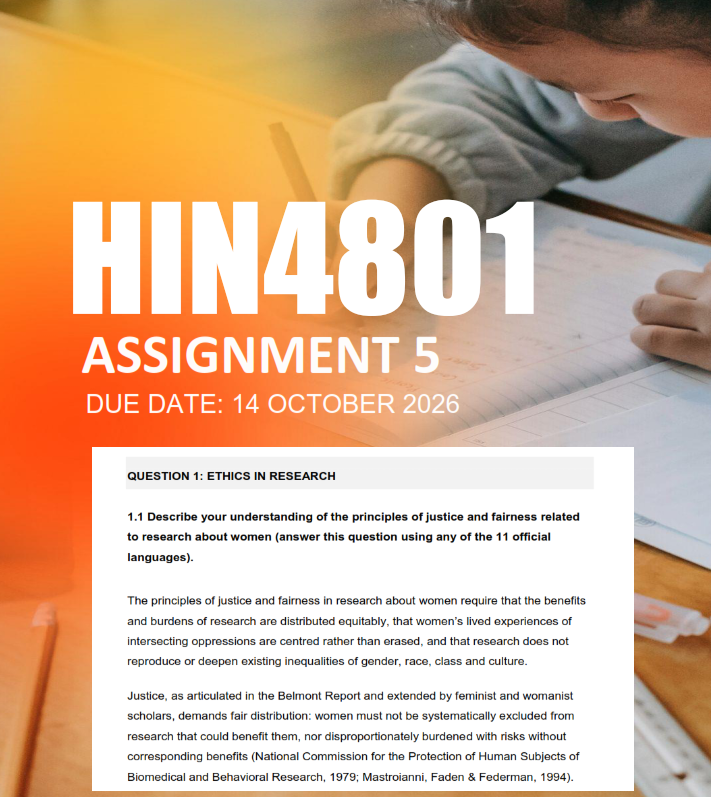
HIN4801 ASSIGNMENT 5/2026
UNIVERSITY ASSESSMENT
Assignment 5
HIN4801: ethics, validity, reliability, trustworthiness, research rigour,
analysis, presentation and interpretation,
Type: File upload
Opens: 05 October 2026
Due date: 14 October 2026
Duration: 9 days
Marks: 50
Primary Lecturer: Dr MW Rammutloa
Internal Moderator: Prof JR Maluleka
External Moderator: Dr A Molaudzi
Submission guidelines
• Upload your answer files in a single PDF file. If you submit more than one
answer file, then only the last file uploaded and submitted will be marked.
• Do not password-protect the assignment answer file.
• No emailed answer files (assignments) will be accepted or marked.
• Preview your submission (answer file) to ensure legibility and that the correct
answer file has been uploaded.
• Incorrect file format and uncollated answer scripts will not be considered
• Save your assessment with your initials_ surname_ module code and
assignment number, i.e. JP_Simelane_HIN4801/5. This will assist you in
submitting the correct assignment file.
• Use Microsoft Word to type your Assessment. No handwritten or scanned
assessments will be accepted.
• Convert your assessment file to PDF and upload it as one PDF document on the
myUnisa platform.
[Scroll to the next page]
Open Rubric
HIN4801 ASSIGNMENT 5/2026
1 | P a g e
IMPORTANT
• This question paper consists of 3 pages and 3 questions.
• Answer all the assignment questions.
• Number your assignment answers correctly.
• Check the mark allocation for each question to determine how much information
should be included in each answer.
• You will not be able to complete the assignment successfully unless your answers
reflect the use of relevant, authoritative information sources.
• Support your answers with evidence from literature or authoritative and credible
information sources.
• Consult relevant, scholarly information resources and make sure that you
acknowledge them in the text references, as well as in the list of references.
• DO not copy information verbatim (word-for-word) from any source/s. Acknowledge
each consulted information source using a text reference and an entry in the
reference list at the end of the assignment.
• You will be penalised if you do not acknowledge the work of other scholars in text
references and/or if all text references are not captured in the reference list at the end
of the assignment.
• Do not copy information from Artificial Intelligence (AI) tools and paste it into your
assignment. You will be penalised for using AI tools irresponsibly.
• Turnitin will be used to check the similarity of the information you provide with that
contained in other sources. All students are expected to accept the End-User License
Agreement (EULA) when prompted to do so.
• Plagiarism is a violation of academic integrity, and students who plagiarise or copy
verbatim from published works will be in violation of the Policy on Academic Integrity
and the Student Disciplinary Code and may be referred to a disciplinary hearing.
UNISA has zero tolerance for plagiarism and/or any other form of academic
dishonesty.
• Late submissions are not allowed; there will NOT be any extensions granted to submit
the assignment after the due date.
PLEASE NOTE THAT THE USE OF AUTHORITATIVE SOURCES TO SUPPORT YOUR
ARGUMENTS AND ANSWERS IS COMPULSORY. YOU WILL BE PENALISED FOR NOT
ADHERING TO THIS INSTRUCTION.
HIN4801 ASSIGNMENT 5/2026
ASSESSMENT 5 QUESTIONS
Read the excerpt and answer the questions that follow.
QUESTION 1: ETHICS IN RESEARCH
Feminist, Womanist, Bosadi theorisation can be seen as an “ethical lens based on the lived
realities of women regarding patriarchy, racial oppression, classism and sexism” amongst
others. The ethical principles of justice and fairness are concerned with protecting women in
research. Answer the questions below.
Mark
allocation
1.1
Criteria
Describe your understanding of the principles of justice and fairness
related to research about women (answer this question using any of
the 11 official languages).
10
1.2
Discuss the ethical risks that may be experienced in research
regarding the representation of women.
10
1.3
Critically illustrate how the ethical risks identified in 1.2 could be
mitigated. Give examples to support your answer.
10
QUESTION 2: VALIDITY AND RELIABILITY IN RESEARCH
Read the article and answer the following questions.
Rammutloa, MW. 2025. The prospect of citizen science: evolving technologies and changing
paradigms in academic library services in South Africa, Journal of Public Administration and
development alternatives, 10(1), 24-38.
The article can be found on this link https://go.exlibris.link/LY03TjKB
2.1
If you were conducting a quantitative study, justify how you would
test validity and reliability of the instrument you would use.
Using the article as a guide.
10
2.2
The author justified the low response rate. Do you agree /disagree
with this argument? Explain your reasoning to support your choice.
10
Total
[50]
THE END
©2026
UNISA
3 | P a g e




Reviews
There are no reviews yet.