Description

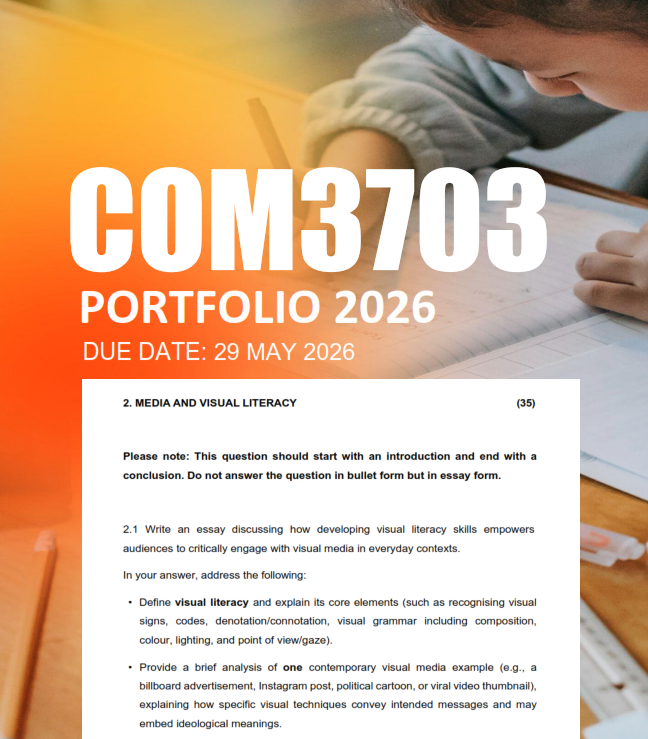
COM3703 Portfolio Semester 1 2026 – Due 29 May 2026


1. INTRODUCTION
(5)


In the introduction, you should clearly identify/indicate what you will discuss in the
assignment and how your assignment is going to be structured. You should refer to
the four themes/study units that you are covering in your assignment, as well as the
topics within the theme on which you will answer questions. Furthermore, in your
introduction, you need to identify by name/title any media texts that you use as
examples in answers to questions.
The introduction should ideally comprise, at most, a paragraph of approximately eight
sentences that cover approximately half a page.

2. MEDIA AND VISUAL LITERACY
(35)


Please note: This question should start with an introduction and end with a
conclusion. Do not answer the question in bullet form but in essay form.

2.1 Write an essay discussing how developing visual literacy skills empowers
audiences to critically engage with visual media in everyday contexts.
In your answer, address the following:

• Define visual literacy and explain its core elements (such as recognising visual
signs, codes, denotation/connotation, visual grammar including composition,
colour, lighting, and point of view/gaze).
• Provide a brief analysis of one contemporary visual media example (e.g., a
billboard advertisement, Instagram post, political cartoon, or viral video thumbnail),
explaining how specific visual techniques convey intended messages and may
embed ideological meanings.


Reference relevant theoretical concepts from the chapter (e.g., semiotics in visuals or
visual discourse) to support your points.

3. TEXTUAL ANALYSIS: NARRATIVE AND ARGUMENT
(35)


According to Prinsloo (2009:206), discourse and ideology are terms that have been
employed to consider and problematise unequal power relations in society. Although
these terms may be used interchangeably at times, they offer different approaches.

3.1 Critically discuss the concept of ‘discourse’.
(5)
3.2 Explain what is meant by the term, ‘ideology’.
(5)
3.3 Discuss Propp’s and Todorov’s approaches to narrative. Highlight one
similarity and one difference between them.
(10)
3.4 Select a television show or advertisement of your choice. Identify and
describe your chosen television show or advertisement.
(3)
3.5 Identify four of Propp’s sequential stages and their corresponding narratives
in your chosen media text.
(12)


4. FIELD RESEARCH IN MEDIA STUDIES
(35)

Reviews

There are no reviews yet.

Only logged in customers who have purchased this product may leave a review.

Description

COM3703 Portfolio Semester 1 2026 – Due 29 May 2026


1. INTRODUCTION
(5)


In the introduction, you should clearly identify/indicate what you will discuss in the
assignment and how your assignment is going to be structured. You should refer to
the four themes/study units that you are covering in your assignment, as well as the
topics within the theme on which you will answer questions. Furthermore, in your
introduction, you need to identify by name/title any media texts that you use as
examples in answers to questions.
The introduction should ideally comprise, at most, a paragraph of approximately eight
sentences that cover approximately half a page.

2. MEDIA AND VISUAL LITERACY
(35)


Please note: This question should start with an introduction and end with a
conclusion. Do not answer the question in bullet form but in essay form.

2.1 Write an essay discussing how developing visual literacy skills empowers
audiences to critically engage with visual media in everyday contexts.
In your answer, address the following:

• Define visual literacy and explain its core elements (such as recognising visual
signs, codes, denotation/connotation, visual grammar including composition,
colour, lighting, and point of view/gaze).
• Provide a brief analysis of one contemporary visual media example (e.g., a
billboard advertisement, Instagram post, political cartoon, or viral video thumbnail),
explaining how specific visual techniques convey intended messages and may
embed ideological meanings.


Reference relevant theoretical concepts from the chapter (e.g., semiotics in visuals or
visual discourse) to support your points.

3. TEXTUAL ANALYSIS: NARRATIVE AND ARGUMENT
(35)


According to Prinsloo (2009:206), discourse and ideology are terms that have been
employed to consider and problematise unequal power relations in society. Although
these terms may be used interchangeably at times, they offer different approaches.

3.1 Critically discuss the concept of ‘discourse’.
(5)
3.2 Explain what is meant by the term, ‘ideology’.
(5)
3.3 Discuss Propp’s and Todorov’s approaches to narrative. Highlight one
similarity and one difference between them.
(10)
3.4 Select a television show or advertisement of your choice. Identify and
describe your chosen television show or advertisement.
(3)
3.5 Identify four of Propp’s sequential stages and their corresponding narratives
in your chosen media text.
(12)


4. FIELD RESEARCH IN MEDIA STUDIES
(35)
Reviews

There are no reviews yet.

Only logged in customers who have purchased this product may leave a review.

0
    0
    Your Shopping Cart
    Your cart is emptyReturn to Shop