Description

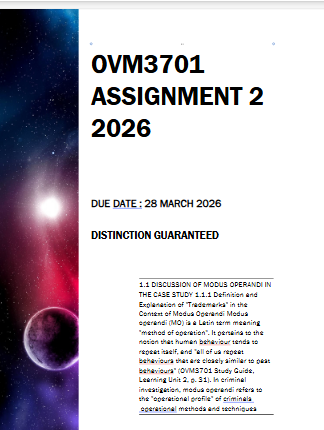
OVM3701 Assignment 2 2026 | Due 28 March 2026 – Distinction Guaranteed.  The widow of the slain Limpopo pharmacist has denied ordering three hitmen to kill her husband. She says she only wanted them to scare him. Tladi was shot and wounded and then driven in the boot of his Mercedes-Benz to Marble Hall, where he was “finished off”, allegedly by Mogalaka. Tladi’s widow told the court through her counsel, Johan van Wyk, that she would state in her evidence that she did not ask the men to kill her husband “but to scare him” so that he would return to their Pretoria home. Van Wyk said his client refused to pay the hitmen R150 000 each for their part in the murder but offered them R3 000 plus R500. This was refuted by Snyman, who said that the payment had been discussed at one of several meetings at Mogakala’s house. He said the widow told them “she wants us to kill her husband”. Van Wyk, who is also representing Sithole, a family friend, said his client would say in her evidence that she received a telephone call from Mogalaka to say that Tladi was wounded. She told Mogalaka to leave Tladi and not to harm him any further. Asked if he knew of such a telephone conversation, Snyman said he did not. He told the court how he fled from Tladi’s house on the night of the murder because he was scared of what was going to happen. Snyman said he made a call to Makhobela, who was waiting in a getaway car some distance from Tladi’s house. He said Mogalaka, who had entered the victim’s house, came back later asking them for their help (Sowetan LIVE, 2006). Question 1 Please note that in answering the questions below, you will be expected to include the following: the title, a cover page, a table of contents, an introduction, a definition of the concepts, a discussion, a conclusion and a list of references. (45) 1.1 Discuss the modus operandi used in the above case study. 1.1.1 Explain what the term “trademarks” means in the context of modus operandi. (5) 1.1.2 Identify the trademarks that form part of the criminals’ modus operandi in the planning phase, while committing the crime, and after committing the crime using the above case study. OVM3701 Assignment 1 Semester 1 2026 (30)


Reviews

There are no reviews yet.

Only logged in customers who have purchased this product may leave a review.

Description

OVM3701 Assignment 2 2026 | Due 28 March 2026 – Distinction Guaranteed.  The widow of the slain Limpopo pharmacist has denied ordering three hitmen to kill her husband. She says she only wanted them to scare him. Tladi was shot and wounded and then driven in the boot of his Mercedes-Benz to Marble Hall, where he was “finished off”, allegedly by Mogalaka. Tladi’s widow told the court through her counsel, Johan van Wyk, that she would state in her evidence that she did not ask the men to kill her husband “but to scare him” so that he would return to their Pretoria home. Van Wyk said his client refused to pay the hitmen R150 000 each for their part in the murder but offered them R3 000 plus R500. This was refuted by Snyman, who said that the payment had been discussed at one of several meetings at Mogakala’s house. He said the widow told them “she wants us to kill her husband”. Van Wyk, who is also representing Sithole, a family friend, said his client would say in her evidence that she received a telephone call from Mogalaka to say that Tladi was wounded. She told Mogalaka to leave Tladi and not to harm him any further. Asked if he knew of such a telephone conversation, Snyman said he did not. He told the court how he fled from Tladi’s house on the night of the murder because he was scared of what was going to happen. Snyman said he made a call to Makhobela, who was waiting in a getaway car some distance from Tladi’s house. He said Mogalaka, who had entered the victim’s house, came back later asking them for their help (Sowetan LIVE, 2006). Question 1 Please note that in answering the questions below, you will be expected to include the following: the title, a cover page, a table of contents, an introduction, a definition of the concepts, a discussion, a conclusion and a list of references. (45) 1.1 Discuss the modus operandi used in the above case study. 1.1.1 Explain what the term “trademarks” means in the context of modus operandi. (5) 1.1.2 Identify the trademarks that form part of the criminals’ modus operandi in the planning phase, while committing the crime, and after committing the crime using the above case study. OVM3701 Assignment 1 Semester 1 2026 (30)

Reviews

There are no reviews yet.

Only logged in customers who have purchased this product may leave a review.

0
    0
    Your Shopping Cart
    Your cart is emptyReturn to Shop