Description

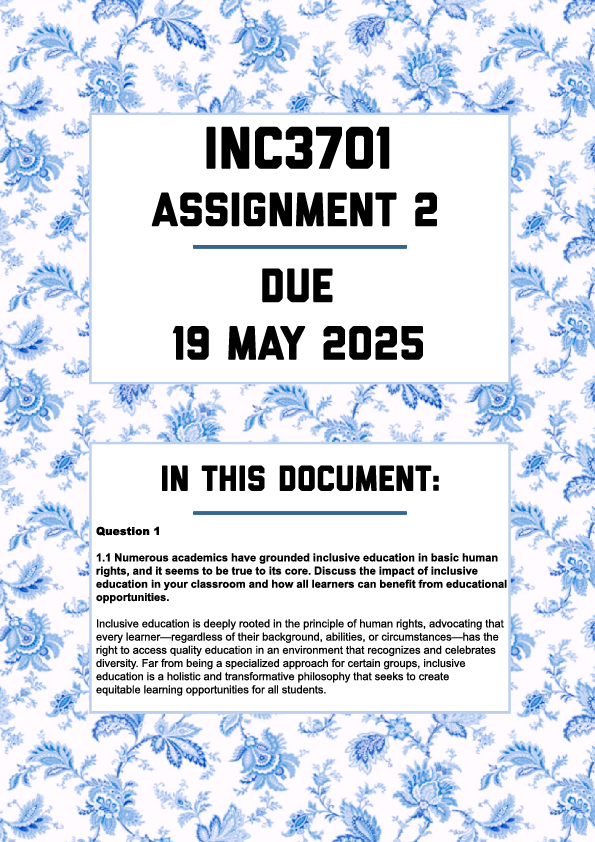
INC3701 Assignment 2 Memo | Due 19 May 2025. All questions fully answered. QUESTION 1
1.1. Numerous academics have grounded inclusive education in basic human rights, and it
seems to be true to its core. Discuss the impact of inclusive education in your classroom and how
all learners can benefit from educational opportunities.
1.2. Education White Paper 6 (DoE, 2001) suggests that individual teachers possess the skills
and expertise to identify barriers to learning. Discuss how you will support learners in the
classroom and collaborate with other support providers to identify the levels of support needed
by learners and to adapt the curriculum to meet the needs of all learners.
QUESTION 2
2. Most learners in South Africa have been denied quality education and have had unequal
opportunities to succeed. Explain two South African policies and two international treaties that
eradicate exclusion practices in education.
QUESTION 3
3. The provision of quality education is at the heart of the SDGs. Discuss SDG 4’s targets and
commitments to universalise access to quality basic education for all learners.
QUESTION 4
4. If teachers are negative towards inclusive education, it will be difficult for them to provide
quality education to all learners. Explain strategies you will apply to ensure that teachers in the
classroom setting accommodate the diverse range of learning needs.
QUESTION 5
5.1. The groundbreaking constitution adopted by South Africa (Republic of South Africa, 1996)
legislates that all people are equal and thus have equal rights, including the fundamental right
to basic education. Identify and discuss 2 factors that impede and 3 that enable (support) the
implementation of Inclusive Education in South Africa.
5.2. According to the National Strategy on Screening, Identification, Assessment and Support
(SIAS) policy (DoE, 2014), education assessment can be defined as “the process of identifying,
gathering and interpreting information”. Discuss two principles of assessment that promote
effective teaching and learning.
5.3. The Screening, Identification, Assessment and Support (SAIS) policy in South Africa was
designed to ensure that teachers and schools understand and respond appropriately to the needs
of diverse learners. Investigate the perceptions of teachers regarding the implementation of the
SIAS policy as an integral part of inclusive education toward addressing their needs.
 

Reviews

There are no reviews yet.

Only logged in customers who have purchased this product may leave a review.

Description

INC3701 Assignment 2 Memo | Due 19 May 2025. All questions fully answered. QUESTION 1
1.1. Numerous academics have grounded inclusive education in basic human rights, and it
seems to be true to its core. Discuss the impact of inclusive education in your classroom and how
all learners can benefit from educational opportunities.
1.2. Education White Paper 6 (DoE, 2001) suggests that individual teachers possess the skills
and expertise to identify barriers to learning. Discuss how you will support learners in the
classroom and collaborate with other support providers to identify the levels of support needed
by learners and to adapt the curriculum to meet the needs of all learners.
QUESTION 2
2. Most learners in South Africa have been denied quality education and have had unequal
opportunities to succeed. Explain two South African policies and two international treaties that
eradicate exclusion practices in education.
QUESTION 3
3. The provision of quality education is at the heart of the SDGs. Discuss SDG 4’s targets and
commitments to universalise access to quality basic education for all learners.
QUESTION 4
4. If teachers are negative towards inclusive education, it will be difficult for them to provide
quality education to all learners. Explain strategies you will apply to ensure that teachers in the
classroom setting accommodate the diverse range of learning needs.
QUESTION 5
5.1. The groundbreaking constitution adopted by South Africa (Republic of South Africa, 1996)
legislates that all people are equal and thus have equal rights, including the fundamental right
to basic education. Identify and discuss 2 factors that impede and 3 that enable (support) the
implementation of Inclusive Education in South Africa.
5.2. According to the National Strategy on Screening, Identification, Assessment and Support
(SIAS) policy (DoE, 2014), education assessment can be defined as “the process of identifying,
gathering and interpreting information”. Discuss two principles of assessment that promote
effective teaching and learning.
5.3. The Screening, Identification, Assessment and Support (SAIS) policy in South Africa was
designed to ensure that teachers and schools understand and respond appropriately to the needs
of diverse learners. Investigate the perceptions of teachers regarding the implementation of the
SIAS policy as an integral part of inclusive education toward addressing their needs.


Reviews

There are no reviews yet.

Only logged in customers who have purchased this product may leave a review.

0
    0
    Your Shopping Cart
    Your cart is emptyReturn to Shop