Description

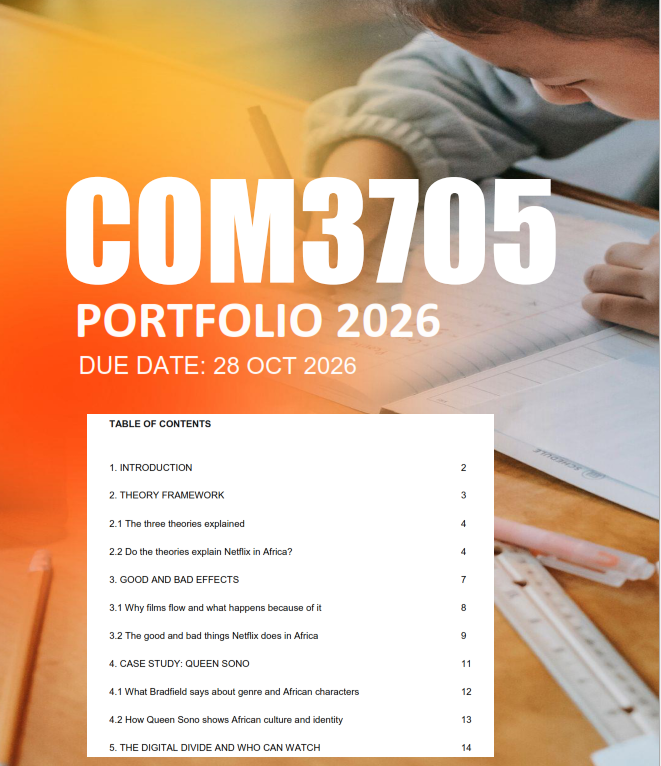
COM3705

Oct/Nov 2026

UNIVERSITY EXAMINATIONS


Oct/Nov 2026

COM3705

International Communication

100 Marks
Portfolio Examination Assessment

EXAMINERS:
FIRST: Ms M van der Walt Ehlers
SECOND: Prof Julie Reid

This paper consists of 10 pages.

Instructions:

Your examination portfolio assignment must be submitted as a typed PDF
document. You may not submit a handwritten document.

Follow all instructions listed below regarding the compulsory submission of a
Declaration of Originality. Your submission will be automatically scanned through
Turnitin to check for plagiarism and the use of artificial intelligence (AI).

You must submit your portfolio assignment via the official myUnisa online
submission system – emailed submissions cannot be accepted.

Please submit your examination portfolio on/before the due date/deadline as NO
extensions will be granted for the examination portfolio.


Page 1 of 10

COM3705

Oct/Nov 2026
COM3705 SEMESTER 2, 2026
ASSIGNMENT 03 – Portfolio

Due date:

30 October 2026
Unique assignment number

168428
Total marks for this assignment

100
Contribution to semester mark

55%

• Read the scenario below carefully before attempting any question.
• Your answer must draw on concepts and theories from Learning Unit 2 (Agency,
Continuity and Discontinuity), Learning Unit 3 (Broadcasting and Film), and Learning
Unit 6 (The Network Society and Digital Divide).
• You must reference AT LEAST FOUR of the prescribed readings listed below, in
addition to your Study Guide.
• Critically integrate the content from the prescribed readings listed below. Each
question specifies which readings are required.
• All sources must be referenced using the Harvard referencing style within your
answers.
• Write in clear, well-structured academic prose. Bullet-point responses will not earn
full marks.
• Structure your assignment correctly and adhere to all Technical Presentation
guidelines (see CMNALLE/301)
Page 2 of 10

COM3705

Oct/Nov 2026
Prescribed readings
● Afilipoaie, A., Iordache, C. & Raats, T. 2021. The ‘Netflix Original’ and what it means
for the production of European television content. Critical Studies in Television: The
International Journal of Television Studies, 16(3):304-325.
● Bradfield, S-J. 2023. Queen Sono: Netflix Original as postfeminist South African spy
thriller. Critical Studies in Television: The International Journal of Television Studies
18(2):163-184.
● Lobato, R. 2018. Rethinking international TV flows research in the age of Netflix.
Television & New Media 19(3):241-256.
● Simon, GI. 2021. Adapting to context: Creative strategies of video streaming services
in Nigeria. Convergence: The International Journal of Research into New Media
Technologies 27(6):1770-1788.
● Thuillas, O. & Wiart, L. 2023. Cultural diversity according to Netflix: a means of
legitimizing an industrial strategy? Études de communication 60:155-174.
Page 3 of 10

COM3705

Oct/Nov 2026
SCENARIO
Since licensing its first Nigerian acquisition, Lionheart, in 2018, Netflix has positioned
Africa as what one of its content executives called “one of the major creative centres for
great storytelling that resonates around the world.” The platform’s first fully commissioned
African Original, the South African spy thriller Queen Sono (2020, directed by Kagiso
Lediga, starring Pearl Thusi), was marketed under the tagline “Made in Africa, Seen by the
World” and shot across 37 locations spanning South Africa, Kenya, Zanzibar and Nigeria.
It was followed by Blood & Water, a Cape Town–set youth drama produced by Gambit
Films, which became the first South African series to reach number one on Netflix’s chart
in the United States, drawing more than seven million viewers within its opening weeks
and running to a fourth season by 2023.
Netflix’s investment in South Africa has been substantial and public. At the 2022 South
African Investment Conference, the company pledged over ZAR920 million toward four
productions, including the international series One Piece (filmed at Cape Town Film
Studios) and further seasons of Blood & Water. By 2024, Netflix reported having invested
more than R4 billion (approximately USD 219 million) in South African film and television
production since 2021, alongside multi-title partnerships with local production houses such
as Gambit Films, Burnt Onion Productions and Black Brain Pictures.
Nigeria followed a similar, though more fragile, trajectory. Since 2016, Netflix has invested
over USD 23 million in the Nigerian industry, backing more than 250 locally licensed titles,
co-productions and original commissions, including King of Boys and The Wedding Party
2. In 2020, Netflix signed its first African multi-title deal with producer Mo Abudu’s
EbonyLife Studios, resulting in titles such as Oloture and Blood Sisters. In 2021, it struck a
three-film deal with director Kunle Afolayan, under which Netflix holds the local and
international licence for up to fifteen years before rights revert to Afolayan — a structure
Afolayan initially described as allowing filmmakers to be “earning in dollars with
guaranteed contracts.”
That confidence was tested in November 2024, when Netflix paused new commissioning
of Nigerian Originals, reportedly reducing planned new titles from around fifteen to ten.
Afolayan told the 2024 Zuma International Film Festival that several projects
commissioned alongside his own had been cancelled “due to low Return on Investment,”
even as his own completed seasons of Aníkúlápó were spared. Netflix publicly denied any
intention to exit the Nigerian market, attributing the pullback to Nigeria’s large population
relative to its comparatively small subscriber base, alongside persistent piracy of newly
released titles. The episode drew comparisons to Amazon Prime Video’s own exit from
Nigeria earlier in 2024.
Affordability and access remain contested on both ends of the continent. In July 2024,
Netflix raised its Nigerian subscription prices by up to 40% (its Premium tier rising to
roughly USD 4.40 a month), a move debated against a backdrop of currency instability
and shrinking discretionary income. In South Africa, Netflix raised its Basic, Standard and
Premium tiers again in mid-2025 (its Basic tier, at R99, was left unchanged), bringing its
cumulative price increase since 2018 to over 35% on some tiers. That same year,
Nomvuyiso Batyi, CEO of South Africa’s Association of Comms and Technology (ACT),
publicly argued that platforms like Netflix consume substantial local network bandwidth
“without contributing to their maintenance or build costs,” calling for such platforms to help
fund the infrastructure their content depends on. Estimates placed Netflix’s South African
subscriber base at just over 2 million in 2024 — behind both Showmax and YouTube
Premium in the same market, and a small fraction of the more than 238 million
subscribers Netflix reports worldwide.
Page 4 of 10

COM3705

Oct/Nov 2026
Netflix’s own public communications frame this involvement as a story of partnership and
creative opportunity: “supporting diversity in both forms and formats,” in the words of one
of its own promotional statements, and “uncovering unique perspectives and diverse
stories” for a global audience. Critics and industry commentators read the same evidence
differently — as evidence of a platform that can extend guaranteed, dollar-denominated
investment into African production one year, and withdraw it just as unilaterally the next,
once its own return-on-investment calculations change.
QUESTIONS
1 Introduction (5 marks)
Write an academic introduction that contextualises Netflix’s engagement with African content
within international communication scholarship, and provides a brief roadmap of the
argument your answer will develop. Your introduction should also name the theoretical
perspective(s) your answer will primarily draw on.
2 Theoretical framework (20 marks)
2.1 Theoretical overview (6 marks)
Define cultural imperialism, dependency theory, and world-systems theory, drawing on
Learning Unit 2.
2.2 Application (14 marks)
Using Lobato (2018), discuss the extent to which these theories help explain, or fail to fully
explain, Netflix’s relationship with African film industries as described in the scenario. You
may also draw on Thuillas & Wiart (2024), who argue that Netflix’s public discourse on
“cultural diversity” functions partly to legitimise its industrial strategy. Does this complicate or
reinforce a media/cultural imperialism reading of the scenario? Support your discussion with
specific evidence from the scenario.
3 Positive and negative effects (20 marks)
3.1 Theoretical overview (6 marks)
Explain the following TWO concepts from Learning Unit 3 relating to the global flow and
distribution of film:
3.2.1 Reasons for current patterns of flow
3.2.2 The consequences of international flow and distribution.
3.2 Application (14 marks)
Discuss the positive and negative effects of Netflix’s involvement in African film and
television industries, using the concepts you defined above and specific evidence from the
scenario. Draw on Afilipoaie et al’s (2021) analysis of Netflix’s release strategies to support
at least one point in your discussion.
4 Case study (20 marks)
4.1 Theoretical overview (3 marks)
Briefly summarise Bradfield’s (2023) argument about how genre conventions can constrain
the representation of African characters and settings in a Netflix Original.
4.2 Application (17 marks)
Page 5 of 10

COM3705

Oct/Nov 2026
Choose ONE Netflix African Original — either one mentioned in the scenario (e.g. Queen
Sono or Blood & Water) or another title you have found and can properly cite — and discuss
how it represents African culture, identity and values, and what it illustrates about patterns of
global consumption and distribution of African-produced content.
5 Digital divide and access (20 marks)
5.1 Theoretical overview (6 marks)
Briefly explain Castells’s concept of the network society and the digital divide, drawing on
Learning Unit 6.
5.2 Application (14 marks): Discuss how unequal access to data, devices and affordability
across Africa shapes who can actually consume Netflix’s African content, using the
scenario’s evidence on pricing and infrastructure. Draw on Simon’s (2021) account of
infrastructure and affordability barriers to streaming in Nigeria to support your discussion.
Your application should also include ONE current statistic relevant to affordability or access
(e.g. a current Netflix subscription price, or the current cost of mobile data in South Africa),
with its source.
6 Conclusion (5 marks)
Conclude by debating whether classic media/cultural imperialism theory remains adequate
to explain Netflix’s role in African media production, or whether ideas around counter-flow or
reverse flow better capture what is actually happening. Thuillas & Wiart (2024) suggest that
platforms like Netflix use “diversity” as a legitimising strategy for what remains, at heart, an
industrial and commercial logic — you may use this argument to sharpen your position either
way. Your conclusion should also include a brief note on how this topic connects (or doesn’t)
to your own experience as a media or streaming consumer.
Technical presentation (10 marks)

TOTAL (100 marks)

Technical Presentation

Please refer to Tutorial Letter CMNALLE/301 for detailed information about the technical
presentation of assignments. The technical presentation criteria applicable to this assignment
are the following:

• Include a Title Page as the first page of your assignment. The title page must include
the module code (COM3705), your full names, your student number, the number of the
assignment (example; “Assignment 01”), and the unique number for the assignment
(available above and/or on myUnisa).
• Include a signed DECLARATION OF ORIGINALITY (refer to Tutorial letter
CMNALLE/301 for details and/or see below).
• Include a Table of Contents as the second page of your assignment. The table of
contents must correspond with the numbering, headings, and sub-headings in the
assignment. Correct page numbers must be supplied.
• Include a technically correct list of Sources Consulted as the final page of your
assignment. All sources referenced must be cited in the list of Sources Consulted,
including any of the prescribed readings to which you refer in your answers (refer to
Tutorial letter CMNALLE/301 for details).

Page 6 of 10

COM3705

Oct/Nov 2026
DEPARTMENT OF COMMUNICATION SCIENCE AI USAGE STANCE

Plagiarism/ AI Declaration

The Department of Communication Science encourages the responsible use of AI tools. That
being said, you are not allowed to copy and paste from AI tools directly to your assignment.
Submitting AI-generated content as your own work constitutes plagiarism. This includes
copying text generated by AI tools, using AI to rewrite your work, or submitting any part of an
AI-generated text. It is essential to recognise that AI tools, particularly Gen AI, cannot meet
the requirements for authorship, as they are non-legal entities and cannot take responsibility
for the submitted work.

There are, however, several ways you can ethically use AI tools:
• For technical assistance, such as grammar and spelling checks, formatting help, or
ensuring your references follow the correct style guide. Think of this as similar to using
tools like Grammarly or MS Word’s spelling checker.
• For clarification of concepts you find difficult to understand, similar to how you might
use a dictionary or thesaurus. However, you must then express these concepts in your
own words.
• To generate discussion questions that might help you think more deeply about your
chosen argument or topic, which you then answer yourself.
• To brainstorm potential approaches or structures for your analysis, which you then
develop independently.

The Department of Communication Science uses Turnitin as a proctoring tool for assignments,
which generates a similarity report and an AI report. You cannot use AI to write your
assignments. Having AI generate the content, analysis, or critical thinking required for this task
constitutes academic misconduct. The university expects assessments to reflect your own
understanding, analysis, and intellectual engagement with the material.

Remember: It is your responsibility to ensure that you understand and adhere to the ethical
responsibilities of academic integrity as it relates to AI. Failure to abide by the policy provisions
can land you in trouble and endanger your academic record and future career, as well as
short-circuiting the learning process that is at the heart of tertiary education.

When you use AI to locate sources or provide a summary of views on a particular subject, you
are taking the risk that the output generated is inaccurate, biased, or fabricated. It is your
responsibility to use the information transparently and responsibly, which can be jeopardised
by practices that undermine academic integrity.

You need to acknowledge the tools you use to support your ideas.

Responsible use of generative AI tools involves leveraging these technologies to enhance
learning and research while upholding the ethical standards of academic integrity. Before you
use AI tools, you must familiarise yourself with the content of the module and the relevant
readings. You have the obligation to clearly declare how and for what purposes you have
consulted AI.

If you decide to use AI tools during any part of the academic writing process (including idea
generation or source location), it becomes your unavoidable responsibility to ensure that the
information that you convey is accurate. This means that you must verify the sources that are
generated to ensure both that they exist and that they provide the data, view, or argument that
the AI output attributes to them. You are responsible for verifying the accuracy of the
statements you make, so be careful which sources you employ and always validate the work
that you are presenting.
Page 7 of 10

COM3705

Oct/Nov 2026

Note that you may not use generative AI tools to author any portion of your assessment. You
may not cut-and-paste text written by AI into your own submission. Be aware that your
submission will be scanned by Turnitin for both plagiarism and AI-written content. You will not
receive any marks for plagiarised text, nor work that has been written by AI. Violating these
principles of academic integrity can result in disciplinary action.

In line with our position on AI, all students are required to submit a declaration form (available
in the Additional Resources folder on the myUnisa site) and submit it with their assignments.
Should a student not submit their declaration form, their assessment marks will not be
released until their declaration form is submitted.


COMPULSORY DECLARATION OF ORIGINALITY

You must include a DECLARATION OF ORIGINALITY in each of your assignments and in
your examination portfolio. The DECLARATION must be included in your written
assessment on the second page of the document, directly after the Title Page and directly
before the Table of Contents.

The template for the DECLARATION is included here below for your reference, but
please note that you must download the MSWord version of the DECLARATION from
the COM3705 myUnisa site in the Additional Resources folder, complete it, and
include it on the second page of your assignments/portfolio.

The DECLARATION has to be signed by yourself and a witness. It is a legally binding
document, and every university has one for students. As we are a distance education
institution and your work has to be submitted online, and you might not have access to a
scanner, we accept typed signatures and e-signatures.

This DECLARATION and all the documents it refers to, will be available on myUnisa, at the
beginning of each academic semester under Additional Resources.

Page 8 of 10

COM3705

Oct/Nov 2026
DECLARATION OF ORIGINALITY

NAME AND SURNAME:

MODULE CODE:

STUDENT NUMBER:

SIGNATURE:

DATE:

WITNESS (Name & surname):

SIGNATURE:

DATE:

I confirm that:

1. ☐ This module contains my own, original ideas and work. Those ideas, or work,
that are not my own, have been cited through the prescribed referencing system,
which I have familiarised myself with in Tutorial Letter CMNALL/E/301.
2. ☐ I have not submitted the ideas or work contained in this MODULE for any other
tertiary education credit.
3. ☐ I have not allowed, and will not allow anyone, to copy my work with the intention
of passing it off as his or her own work.
4. ☐ I did not make use of another student’s work and submitted it as my own.
5. ☐ I have read through the entire tutorial letter (TL_20264_CMNALL/E 301_4_B) on
academic writing and am familiar with the guidelines applicable to this module.
6. ☐ I am aware of what academic dishonesty entails and have read and understood
UNISA’s policies in this regard (click on the links below to access these
documents):
i. Unisa Policy of Research Ethics
ii. Plagiarism PowerPoint for Under-Graduate Studies (available under
“Additional Sources” on the course site on myUnisa)
iii. Unisa’s Library Guides on Plagiarism and Ethics
iv. Policy For Copyright Infringement And Plagiarism
v. Unisa Policy on Academic Integrity
7. ☐ Transparency statement: you are required to write your own transparency statement
here in which you declare the electronic tools that you used in completing this
assessment. This could include search engines (such as www.google.com), scholarly
search engines (such as scholar.google.com), or language editing tools (such as
www.grammarly.com). In keeping with the university’s formal position on academic
integrity you must also declare the use of any generative artificial intelligence (AI)
tools that you have used to summarise, or to assist with generating ideas. If you have
made use of AI tools you must list the name of the tool and also describe the way in
which you used it. (for example, “I used ChatGPT and I asked it to explain the
assignment question to me so that I could understand it more clearly” or “I have used
an AI tool for editing.”). You are required to answer the following questions and submit
them with your assessment as part of the transparency statement.

1. In which question did you use AI? Indicate the question number.
Answer:

Page 9 of 10

COM3705

Oct/Nov 2026
2. Identify the AI tools used.
Answer:

3. How did you use AI to enhance your own thinking and understanding?
Answer:

4. Which prompts did you use? Link the prompt to a specific question number.
Answer:

5. Which parts of the AI answer did you incorporate with your own thinking? Elaborate
on the process.
Answer:


UNISA copyright © 2026
Page 10 of 10

Reviews

There are no reviews yet.

Be the first to review “COM305 Exam Portfolio Semester 2 2026 – Due 28 October 2026”

Your email address will not be published. Required fields are marked *

Description

COM3705

Oct/Nov 2026

UNIVERSITY EXAMINATIONS


Oct/Nov 2026

COM3705

International Communication

100 Marks
Portfolio Examination Assessment

EXAMINERS:
FIRST: Ms M van der Walt Ehlers
SECOND: Prof Julie Reid

This paper consists of 10 pages.

Instructions:

Your examination portfolio assignment must be submitted as a typed PDF
document. You may not submit a handwritten document.

Follow all instructions listed below regarding the compulsory submission of a
Declaration of Originality. Your submission will be automatically scanned through
Turnitin to check for plagiarism and the use of artificial intelligence (AI).

You must submit your portfolio assignment via the official myUnisa online
submission system – emailed submissions cannot be accepted.

Please submit your examination portfolio on/before the due date/deadline as NO
extensions will be granted for the examination portfolio.


Page 1 of 10

COM3705

Oct/Nov 2026
COM3705 SEMESTER 2, 2026
ASSIGNMENT 03 – Portfolio

Due date:

30 October 2026
Unique assignment number

168428
Total marks for this assignment

100
Contribution to semester mark

55%

• Read the scenario below carefully before attempting any question.
• Your answer must draw on concepts and theories from Learning Unit 2 (Agency,
Continuity and Discontinuity), Learning Unit 3 (Broadcasting and Film), and Learning
Unit 6 (The Network Society and Digital Divide).
• You must reference AT LEAST FOUR of the prescribed readings listed below, in
addition to your Study Guide.
• Critically integrate the content from the prescribed readings listed below. Each
question specifies which readings are required.
• All sources must be referenced using the Harvard referencing style within your
answers.
• Write in clear, well-structured academic prose. Bullet-point responses will not earn
full marks.
• Structure your assignment correctly and adhere to all Technical Presentation
guidelines (see CMNALLE/301)
Page 2 of 10

COM3705

Oct/Nov 2026
Prescribed readings
● Afilipoaie, A., Iordache, C. & Raats, T. 2021. The ‘Netflix Original’ and what it means
for the production of European television content. Critical Studies in Television: The
International Journal of Television Studies, 16(3):304-325.
● Bradfield, S-J. 2023. Queen Sono: Netflix Original as postfeminist South African spy
thriller. Critical Studies in Television: The International Journal of Television Studies
18(2):163-184.
● Lobato, R. 2018. Rethinking international TV flows research in the age of Netflix.
Television & New Media 19(3):241-256.
● Simon, GI. 2021. Adapting to context: Creative strategies of video streaming services
in Nigeria. Convergence: The International Journal of Research into New Media
Technologies 27(6):1770-1788.
● Thuillas, O. & Wiart, L. 2023. Cultural diversity according to Netflix: a means of
legitimizing an industrial strategy? Études de communication 60:155-174.
Page 3 of 10

COM3705

Oct/Nov 2026
SCENARIO
Since licensing its first Nigerian acquisition, Lionheart, in 2018, Netflix has positioned
Africa as what one of its content executives called “one of the major creative centres for
great storytelling that resonates around the world.” The platform’s first fully commissioned
African Original, the South African spy thriller Queen Sono (2020, directed by Kagiso
Lediga, starring Pearl Thusi), was marketed under the tagline “Made in Africa, Seen by the
World” and shot across 37 locations spanning South Africa, Kenya, Zanzibar and Nigeria.
It was followed by Blood & Water, a Cape Town–set youth drama produced by Gambit
Films, which became the first South African series to reach number one on Netflix’s chart
in the United States, drawing more than seven million viewers within its opening weeks
and running to a fourth season by 2023.
Netflix’s investment in South Africa has been substantial and public. At the 2022 South
African Investment Conference, the company pledged over ZAR920 million toward four
productions, including the international series One Piece (filmed at Cape Town Film
Studios) and further seasons of Blood & Water. By 2024, Netflix reported having invested
more than R4 billion (approximately USD 219 million) in South African film and television
production since 2021, alongside multi-title partnerships with local production houses such
as Gambit Films, Burnt Onion Productions and Black Brain Pictures.
Nigeria followed a similar, though more fragile, trajectory. Since 2016, Netflix has invested
over USD 23 million in the Nigerian industry, backing more than 250 locally licensed titles,
co-productions and original commissions, including King of Boys and The Wedding Party
2. In 2020, Netflix signed its first African multi-title deal with producer Mo Abudu’s
EbonyLife Studios, resulting in titles such as Oloture and Blood Sisters. In 2021, it struck a
three-film deal with director Kunle Afolayan, under which Netflix holds the local and
international licence for up to fifteen years before rights revert to Afolayan — a structure
Afolayan initially described as allowing filmmakers to be “earning in dollars with
guaranteed contracts.”
That confidence was tested in November 2024, when Netflix paused new commissioning
of Nigerian Originals, reportedly reducing planned new titles from around fifteen to ten.
Afolayan told the 2024 Zuma International Film Festival that several projects
commissioned alongside his own had been cancelled “due to low Return on Investment,”
even as his own completed seasons of Aníkúlápó were spared. Netflix publicly denied any
intention to exit the Nigerian market, attributing the pullback to Nigeria’s large population
relative to its comparatively small subscriber base, alongside persistent piracy of newly
released titles. The episode drew comparisons to Amazon Prime Video’s own exit from
Nigeria earlier in 2024.
Affordability and access remain contested on both ends of the continent. In July 2024,
Netflix raised its Nigerian subscription prices by up to 40% (its Premium tier rising to
roughly USD 4.40 a month), a move debated against a backdrop of currency instability
and shrinking discretionary income. In South Africa, Netflix raised its Basic, Standard and
Premium tiers again in mid-2025 (its Basic tier, at R99, was left unchanged), bringing its
cumulative price increase since 2018 to over 35% on some tiers. That same year,
Nomvuyiso Batyi, CEO of South Africa’s Association of Comms and Technology (ACT),
publicly argued that platforms like Netflix consume substantial local network bandwidth
“without contributing to their maintenance or build costs,” calling for such platforms to help
fund the infrastructure their content depends on. Estimates placed Netflix’s South African
subscriber base at just over 2 million in 2024 — behind both Showmax and YouTube
Premium in the same market, and a small fraction of the more than 238 million
subscribers Netflix reports worldwide.
Page 4 of 10

COM3705

Oct/Nov 2026
Netflix’s own public communications frame this involvement as a story of partnership and
creative opportunity: “supporting diversity in both forms and formats,” in the words of one
of its own promotional statements, and “uncovering unique perspectives and diverse
stories” for a global audience. Critics and industry commentators read the same evidence
differently — as evidence of a platform that can extend guaranteed, dollar-denominated
investment into African production one year, and withdraw it just as unilaterally the next,
once its own return-on-investment calculations change.
QUESTIONS
1 Introduction (5 marks)
Write an academic introduction that contextualises Netflix’s engagement with African content
within international communication scholarship, and provides a brief roadmap of the
argument your answer will develop. Your introduction should also name the theoretical
perspective(s) your answer will primarily draw on.
2 Theoretical framework (20 marks)
2.1 Theoretical overview (6 marks)
Define cultural imperialism, dependency theory, and world-systems theory, drawing on
Learning Unit 2.
2.2 Application (14 marks)
Using Lobato (2018), discuss the extent to which these theories help explain, or fail to fully
explain, Netflix’s relationship with African film industries as described in the scenario. You
may also draw on Thuillas & Wiart (2024), who argue that Netflix’s public discourse on
“cultural diversity” functions partly to legitimise its industrial strategy. Does this complicate or
reinforce a media/cultural imperialism reading of the scenario? Support your discussion with
specific evidence from the scenario.
3 Positive and negative effects (20 marks)
3.1 Theoretical overview (6 marks)
Explain the following TWO concepts from Learning Unit 3 relating to the global flow and
distribution of film:
3.2.1 Reasons for current patterns of flow
3.2.2 The consequences of international flow and distribution.
3.2 Application (14 marks)
Discuss the positive and negative effects of Netflix’s involvement in African film and
television industries, using the concepts you defined above and specific evidence from the
scenario. Draw on Afilipoaie et al’s (2021) analysis of Netflix’s release strategies to support
at least one point in your discussion.
4 Case study (20 marks)
4.1 Theoretical overview (3 marks)
Briefly summarise Bradfield’s (2023) argument about how genre conventions can constrain
the representation of African characters and settings in a Netflix Original.
4.2 Application (17 marks)
Page 5 of 10

COM3705

Oct/Nov 2026
Choose ONE Netflix African Original — either one mentioned in the scenario (e.g. Queen
Sono or Blood & Water) or another title you have found and can properly cite — and discuss
how it represents African culture, identity and values, and what it illustrates about patterns of
global consumption and distribution of African-produced content.
5 Digital divide and access (20 marks)
5.1 Theoretical overview (6 marks)
Briefly explain Castells’s concept of the network society and the digital divide, drawing on
Learning Unit 6.
5.2 Application (14 marks): Discuss how unequal access to data, devices and affordability
across Africa shapes who can actually consume Netflix’s African content, using the
scenario’s evidence on pricing and infrastructure. Draw on Simon’s (2021) account of
infrastructure and affordability barriers to streaming in Nigeria to support your discussion.
Your application should also include ONE current statistic relevant to affordability or access
(e.g. a current Netflix subscription price, or the current cost of mobile data in South Africa),
with its source.
6 Conclusion (5 marks)
Conclude by debating whether classic media/cultural imperialism theory remains adequate
to explain Netflix’s role in African media production, or whether ideas around counter-flow or
reverse flow better capture what is actually happening. Thuillas & Wiart (2024) suggest that
platforms like Netflix use “diversity” as a legitimising strategy for what remains, at heart, an
industrial and commercial logic — you may use this argument to sharpen your position either
way. Your conclusion should also include a brief note on how this topic connects (or doesn’t)
to your own experience as a media or streaming consumer.
Technical presentation (10 marks)

TOTAL (100 marks)

Technical Presentation

Please refer to Tutorial Letter CMNALLE/301 for detailed information about the technical
presentation of assignments. The technical presentation criteria applicable to this assignment
are the following:

• Include a Title Page as the first page of your assignment. The title page must include
the module code (COM3705), your full names, your student number, the number of the
assignment (example; “Assignment 01”), and the unique number for the assignment
(available above and/or on myUnisa).
• Include a signed DECLARATION OF ORIGINALITY (refer to Tutorial letter
CMNALLE/301 for details and/or see below).
• Include a Table of Contents as the second page of your assignment. The table of
contents must correspond with the numbering, headings, and sub-headings in the
assignment. Correct page numbers must be supplied.
• Include a technically correct list of Sources Consulted as the final page of your
assignment. All sources referenced must be cited in the list of Sources Consulted,
including any of the prescribed readings to which you refer in your answers (refer to
Tutorial letter CMNALLE/301 for details).

Page 6 of 10

COM3705

Oct/Nov 2026
DEPARTMENT OF COMMUNICATION SCIENCE AI USAGE STANCE

Plagiarism/ AI Declaration

The Department of Communication Science encourages the responsible use of AI tools. That
being said, you are not allowed to copy and paste from AI tools directly to your assignment.
Submitting AI-generated content as your own work constitutes plagiarism. This includes
copying text generated by AI tools, using AI to rewrite your work, or submitting any part of an
AI-generated text. It is essential to recognise that AI tools, particularly Gen AI, cannot meet
the requirements for authorship, as they are non-legal entities and cannot take responsibility
for the submitted work.

There are, however, several ways you can ethically use AI tools:
• For technical assistance, such as grammar and spelling checks, formatting help, or
ensuring your references follow the correct style guide. Think of this as similar to using
tools like Grammarly or MS Word’s spelling checker.
• For clarification of concepts you find difficult to understand, similar to how you might
use a dictionary or thesaurus. However, you must then express these concepts in your
own words.
• To generate discussion questions that might help you think more deeply about your
chosen argument or topic, which you then answer yourself.
• To brainstorm potential approaches or structures for your analysis, which you then
develop independently.

The Department of Communication Science uses Turnitin as a proctoring tool for assignments,
which generates a similarity report and an AI report. You cannot use AI to write your
assignments. Having AI generate the content, analysis, or critical thinking required for this task
constitutes academic misconduct. The university expects assessments to reflect your own
understanding, analysis, and intellectual engagement with the material.

Remember: It is your responsibility to ensure that you understand and adhere to the ethical
responsibilities of academic integrity as it relates to AI. Failure to abide by the policy provisions
can land you in trouble and endanger your academic record and future career, as well as
short-circuiting the learning process that is at the heart of tertiary education.

When you use AI to locate sources or provide a summary of views on a particular subject, you
are taking the risk that the output generated is inaccurate, biased, or fabricated. It is your
responsibility to use the information transparently and responsibly, which can be jeopardised
by practices that undermine academic integrity.

You need to acknowledge the tools you use to support your ideas.

Responsible use of generative AI tools involves leveraging these technologies to enhance
learning and research while upholding the ethical standards of academic integrity. Before you
use AI tools, you must familiarise yourself with the content of the module and the relevant
readings. You have the obligation to clearly declare how and for what purposes you have
consulted AI.

If you decide to use AI tools during any part of the academic writing process (including idea
generation or source location), it becomes your unavoidable responsibility to ensure that the
information that you convey is accurate. This means that you must verify the sources that are
generated to ensure both that they exist and that they provide the data, view, or argument that
the AI output attributes to them. You are responsible for verifying the accuracy of the
statements you make, so be careful which sources you employ and always validate the work
that you are presenting.
Page 7 of 10

COM3705

Oct/Nov 2026

Note that you may not use generative AI tools to author any portion of your assessment. You
may not cut-and-paste text written by AI into your own submission. Be aware that your
submission will be scanned by Turnitin for both plagiarism and AI-written content. You will not
receive any marks for plagiarised text, nor work that has been written by AI. Violating these
principles of academic integrity can result in disciplinary action.

In line with our position on AI, all students are required to submit a declaration form (available
in the Additional Resources folder on the myUnisa site) and submit it with their assignments.
Should a student not submit their declaration form, their assessment marks will not be
released until their declaration form is submitted.


COMPULSORY DECLARATION OF ORIGINALITY

You must include a DECLARATION OF ORIGINALITY in each of your assignments and in
your examination portfolio. The DECLARATION must be included in your written
assessment on the second page of the document, directly after the Title Page and directly
before the Table of Contents.

The template for the DECLARATION is included here below for your reference, but
please note that you must download the MSWord version of the DECLARATION from
the COM3705 myUnisa site in the Additional Resources folder, complete it, and
include it on the second page of your assignments/portfolio.

The DECLARATION has to be signed by yourself and a witness. It is a legally binding
document, and every university has one for students. As we are a distance education
institution and your work has to be submitted online, and you might not have access to a
scanner, we accept typed signatures and e-signatures.

This DECLARATION and all the documents it refers to, will be available on myUnisa, at the
beginning of each academic semester under Additional Resources.

Page 8 of 10

COM3705

Oct/Nov 2026
DECLARATION OF ORIGINALITY

NAME AND SURNAME:

MODULE CODE:

STUDENT NUMBER:

SIGNATURE:

DATE:

WITNESS (Name & surname):

SIGNATURE:

DATE:

I confirm that:

1. ☐ This module contains my own, original ideas and work. Those ideas, or work,
that are not my own, have been cited through the prescribed referencing system,
which I have familiarised myself with in Tutorial Letter CMNALL/E/301.
2. ☐ I have not submitted the ideas or work contained in this MODULE for any other
tertiary education credit.
3. ☐ I have not allowed, and will not allow anyone, to copy my work with the intention
of passing it off as his or her own work.
4. ☐ I did not make use of another student’s work and submitted it as my own.
5. ☐ I have read through the entire tutorial letter (TL_20264_CMNALL/E 301_4_B) on
academic writing and am familiar with the guidelines applicable to this module.
6. ☐ I am aware of what academic dishonesty entails and have read and understood
UNISA’s policies in this regard (click on the links below to access these
documents):
i. Unisa Policy of Research Ethics
ii. Plagiarism PowerPoint for Under-Graduate Studies (available under
“Additional Sources” on the course site on myUnisa)
iii. Unisa’s Library Guides on Plagiarism and Ethics
iv. Policy For Copyright Infringement And Plagiarism
v. Unisa Policy on Academic Integrity
7. ☐ Transparency statement: you are required to write your own transparency statement
here in which you declare the electronic tools that you used in completing this
assessment. This could include search engines (such as www.google.com), scholarly
search engines (such as scholar.google.com), or language editing tools (such as
www.grammarly.com). In keeping with the university’s formal position on academic
integrity you must also declare the use of any generative artificial intelligence (AI)
tools that you have used to summarise, or to assist with generating ideas. If you have
made use of AI tools you must list the name of the tool and also describe the way in
which you used it. (for example, “I used ChatGPT and I asked it to explain the
assignment question to me so that I could understand it more clearly” or “I have used
an AI tool for editing.”). You are required to answer the following questions and submit
them with your assessment as part of the transparency statement.

1. In which question did you use AI? Indicate the question number.
Answer:

Page 9 of 10

COM3705

Oct/Nov 2026
2. Identify the AI tools used.
Answer:

3. How did you use AI to enhance your own thinking and understanding?
Answer:

4. Which prompts did you use? Link the prompt to a specific question number.
Answer:

5. Which parts of the AI answer did you incorporate with your own thinking? Elaborate
on the process.
Answer:


UNISA copyright © 2026
Page 10 of 10
Reviews

There are no reviews yet.

Be the first to review “COM305 Exam Portfolio Semester 2 2026 – Due 28 October 2026”

Your email address will not be published. Required fields are marked *

About this UNISA resource

This downloadable Portfolio Study Resource. Review the document title, description, seller information, price and learner reviews before purchasing to make sure it matches your current module requirements.

StudyPass helps distance-learning students search by module code and discover notes, revision material and study resources shared by independent sellers. Always compare the resource details with your latest official UNISA tutorial letters and assessment instructions.

Search for another UNISA module code or visit the UNISA Study Hub for practical distance-learning and exam-preparation tips.

0
0
Your Shopping Cart
Your cart is emptyReturn to Shop