Description

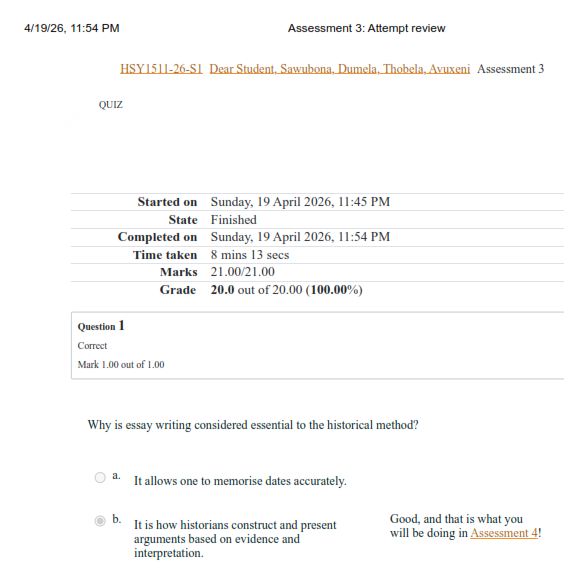
The following assessment is paragraph based and covers Study Units 2 and 3 from your Study Guide. You
will complete an introduction and a conclusion for two provided topics. Both paragraphs should be around 100
to 200 words. Additionally, there is a referencing exercise to be completed. You are also expected to attach
a Plagiarism Declaration (see below). This activity is in preparation for your essay. This assessment is a file
submission, meaning you will upload your answers as a PDF or MS Word Document (preferably PDF). You
do not have to use the assessment template provided and can retype your submission.

For this assessment, you will:

1) Read Lessons on Essay Writing below.

2) Write an introduction for the essay topic provided.

3) Write a conclusion using the essay topic and discussion points provided.

4) Complete the referencing exercise.

5) Attach a signed plagiarism declaration (see below).

LESSONS ON ESSAY WRITING:
In the study of History, we not only wish to teach you about our complex past, but we also want to share
with you the skills of the historian. This includes sharpened reading skills, critical analysis and critique and
use of sources and the writing of essays. The essay is a tool through which we convey a certain point of
view, an argument or defend a stance on a certain historical subject. The essay requires you the student,
to research a topic, organize your thoughts, and present a well-written and well-supported argument. When
writing an essay, it is important to properly reference any sources used in the research and writing process.
This is where referencing comes in. There are several different referencing styles, and it is important to use
the one specified by your lecturer. In History we use the Chicago style of referencing and here we use
footnotes for our intext references. Failure to properly reference sources can be considered plagiarism,
which is a serious academic offense. When referencing, it is important to not only include in-text citations,
but also a list of works referenced or a bibliography at the end of the essay.

Part One: Introduction
Let us turn our attention to the essay introduction. The information in your introduction will be based on
the notes you have made OR knowledge acquired during your reading and research of your chosen topic.
An essay introduction should include an opening sentence that grabs the reader’s attention, background
information on the topic, and a thesis statement outlining the main argument. The thesis statement is the
sentence which states what your essay will be discussing/it offers a concise summary of the main point
your essay; for example: this essay will discuss/be discussing __________ by focussing on __________
(and by using the following examples). This sentence should be placed at the end of your introduction.
Overall, your introduction should be engaging and informative, setting the stage for the rest of the essay.
However, an introduction should be brief, usually around 100 to 200 words.

To recap, your introduction should include:
1. Opening sentence
2. Some background on the topic
3. Thesis statement


Part Two: Referencing
As mentioned earlier, we use the Chicago style of referencing in the field of history. Which includes
footnotes and a bibliography. A footnote is placed at the bottom of the page where the source has been
used and identified with a number
. A bibliography or reference list is placed at the end of your essay (on
the page following your conclusion) and is a list of all the sources you have used/consulted. The sources in
your footnotes and bibliography should be the same. This may seem redundant, but this is the academic
referencing format we use.

Here are examples of how you acknowledge different types of sources in your footnotes:
A tutorial letter (learning unit) or a study guide is listed as follows:
– Tutorial Letter 501 for HSY1511, Learning Unit 1, p. 15.
– Study Guide for HSY2603, p. 49.
– Tutorial Letter 101 for HSY3704, pp. 12–14.
1
I

Reviews

There are no reviews yet.

Only logged in customers who have purchased this product may leave a review.

Description

The following assessment is paragraph based and covers Study Units 2 and 3 from your Study Guide. You
will complete an introduction and a conclusion for two provided topics. Both paragraphs should be around 100
to 200 words. Additionally, there is a referencing exercise to be completed. You are also expected to attach
a Plagiarism Declaration (see below). This activity is in preparation for your essay. This assessment is a file
submission, meaning you will upload your answers as a PDF or MS Word Document (preferably PDF). You
do not have to use the assessment template provided and can retype your submission.

For this assessment, you will:

1) Read Lessons on Essay Writing below.

2) Write an introduction for the essay topic provided.

3) Write a conclusion using the essay topic and discussion points provided.

4) Complete the referencing exercise.

5) Attach a signed plagiarism declaration (see below).

LESSONS ON ESSAY WRITING:
In the study of History, we not only wish to teach you about our complex past, but we also want to share
with you the skills of the historian. This includes sharpened reading skills, critical analysis and critique and
use of sources and the writing of essays. The essay is a tool through which we convey a certain point of
view, an argument or defend a stance on a certain historical subject. The essay requires you the student,
to research a topic, organize your thoughts, and present a well-written and well-supported argument. When
writing an essay, it is important to properly reference any sources used in the research and writing process.
This is where referencing comes in. There are several different referencing styles, and it is important to use
the one specified by your lecturer. In History we use the Chicago style of referencing and here we use
footnotes for our intext references. Failure to properly reference sources can be considered plagiarism,
which is a serious academic offense. When referencing, it is important to not only include in-text citations,
but also a list of works referenced or a bibliography at the end of the essay.

Part One: Introduction
Let us turn our attention to the essay introduction. The information in your introduction will be based on
the notes you have made OR knowledge acquired during your reading and research of your chosen topic.
An essay introduction should include an opening sentence that grabs the reader’s attention, background
information on the topic, and a thesis statement outlining the main argument. The thesis statement is the
sentence which states what your essay will be discussing/it offers a concise summary of the main point
your essay; for example: this essay will discuss/be discussing __________ by focussing on __________
(and by using the following examples). This sentence should be placed at the end of your introduction.
Overall, your introduction should be engaging and informative, setting the stage for the rest of the essay.
However, an introduction should be brief, usually around 100 to 200 words.

To recap, your introduction should include:
1. Opening sentence
2. Some background on the topic
3. Thesis statement


Part Two: Referencing
As mentioned earlier, we use the Chicago style of referencing in the field of history. Which includes
footnotes and a bibliography. A footnote is placed at the bottom of the page where the source has been
used and identified with a number
. A bibliography or reference list is placed at the end of your essay (on
the page following your conclusion) and is a list of all the sources you have used/consulted. The sources in
your footnotes and bibliography should be the same. This may seem redundant, but this is the academic
referencing format we use.

Here are examples of how you acknowledge different types of sources in your footnotes:
A tutorial letter (learning unit) or a study guide is listed as follows:
– Tutorial Letter 501 for HSY1511, Learning Unit 1, p. 15.
– Study Guide for HSY2603, p. 49.
– Tutorial Letter 101 for HSY3704, pp. 12–14.
1
I
Reviews

There are no reviews yet.

Only logged in customers who have purchased this product may leave a review.

0
    0
    Your Shopping Cart
    Your cart is emptyReturn to Shop