
Description
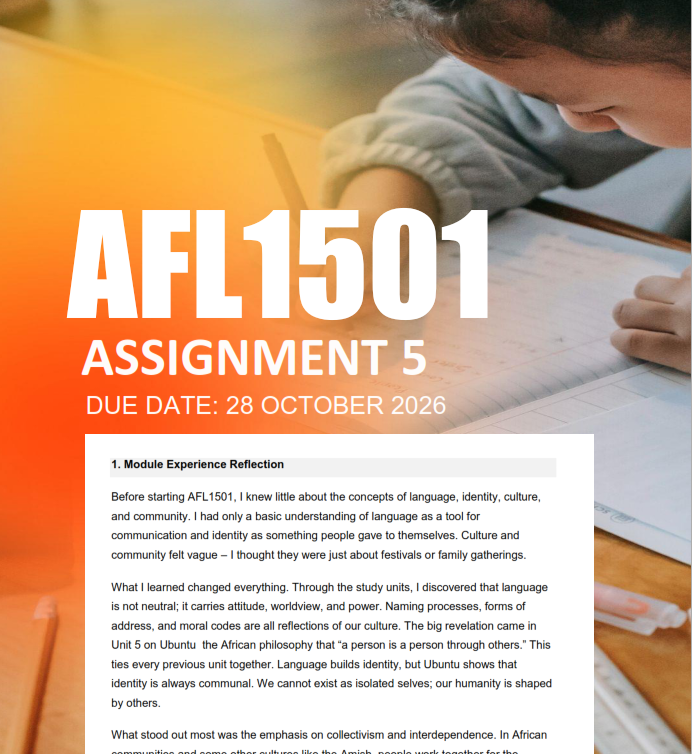
AFL1501 Assignment 5 Semester 2 2026 – Due 28 October 2026
Assessment 5 – 294125
Assessment 5 – 294125Assessment 5 – 294125
294125
Final Assessment 5: Your Portfolio Assessment (100 Marks)
Submission Format: File upload to myUnisa
Submission Instructions:
Please read through all study units before starting with your assignment.
Before uploading, ensure the final version of your work is saved as a PDF, as this is the only
format compatible with the university’s marking tools for providing feedback.
Note: Instead of an examination for this module, we submit a Final Portfolio. This is your
final Assessment, listed as Assessment 05. It’s a summative assessment, and you will not
be allowed to resubmit.
It Is your responsibility to ensure that the file you upload as your Assessment is the correct
file, complete, and accessible to the marker.
Do not, under any circumstances send a hard copy of your Assessment to the university.
NB: You MUST submit your Final Portfolio assessment, or you will NOT pass this module.
Navigate to Assessment within the AFL1501 module.
Click the “Submit” button below the assessment question, then follow the guided steps to
complete the upload.
Academic Integrity Reminder:
All work submitted must be the student’s own. Submitting any portion of another student’s
work, content from the internet, or any external source without proper acknowledgement
constitutes plagiarism. This is a serious academic offence and will result in a mark of 0%
for the assessment and may lead to disciplinary action. All non-original content must be
accurately referenced using the appropriate academic style.
You may visit this website to help you understand academic writing integrity and
referencing:
https://sites.google.com/a/unisacommscience.co.za/writing-for-academic-integrity/home
Your submission must include:
Cover Page
Table of Contents
Page numbers
Declaration of originality
Times New Roman / Arial, Size 12, Spacing 1.5
Do NOT copy from the internet or use AI text-generation
Clear paragraph writing style
Use your own voice and real examples
COVER PAGE;
Your name and surname:
Student Number:
Group Number:
Your Portfolio consists of several elements you have been working on throughout this
module.
Question 1
1. Module experience Reflection
Reflect on your learning journey in AFL1501. How has your understanding of language,
identity, culture, and community changed or developed during the module?
In your reflection, discuss what you knew before, what you learned, and what stood out as
meaningful. (300 words) 15
2. Family Interview
Interview two senior living family members about their names. Provide the English
translation of each name, followed by its definition and an interpretation of its meaning
within the context of the relevant South African culture.
A. What is the relationship between their name and their language?
b. Who gave the person being interviewed their name?
c. What is the story or meaning behind their name?
d. Do they believe they have lived up to the meaning of their name? Explain. (300 words)
15
3. Your Interview/Your Name
If you have a praise or clan name, include it in your response. In addition, answer the
following questions about yourself:
A. What is your name and clan name?
b. Who chose or gave you your name?
c. What is the meaning or story behind your name?
d. What is the relationship between your name and your language or cultural background?
e. Do the people who gave you your name believe that you live up to its meaning? Explain
your answer.
f. Do you believe your name reflects your personality, character, or life experiences? Please
explain.
g. If you had the opportunity to change your name, would you do so? If yes, what name
would you choose, and why? (400 words) 20
Question 2
1. Definition of Culture
Research and provide us with 3 definitions of culture. Include the cultural definitions and
remember to reference them correctly. Do not include a dictionary definition.
Which definition do you agree with and feel applies to you, and why? Should culture and
tradition be allowed to evolve? If yes, why? If no, why? (300 words) 15
2. Ukuhlonipha
In Zulu culture, politeness is closely linked to respect. This is expressed through
ukuhlonipha, a long-standing code of respect that guides how people relate to their
families, elders, ancestors, and the wider community. Respect can take many forms, for
example, ukuhlonipha abesifazane (respect for women), ukuhlonipha abaphansi (respect
for the ancestors), and ukuhlonipha abantu abadala (respect for older people).
One everyday example of this code is that children do not call their older siblings by name
alone; instead, they use a term of respect, such as bhuti (older brother), before the name,
e.g. bhuti Musa, to acknowledge the age difference.
With this in mind, complete the following:
a. Identify and discuss two expressions of politeness from your own culture and/or
beliefs. For each expression, explain how it is similar to or different from
ukuhlonipha described above.
b. In your opinion, is politeness shaped by culture? Provide reasons to support your
answer.
c. Would you regard someone who does not observe these forms of politeness as
being “uncultural”? Substantiate your response with relevant reasons.
D. Explain how you can show politeness when communicating with your lecturers, tutors
(group leaders), and fellow students at university. (400 words)
20
Question 3 – Final Reflection
Final Reflection: Have you experienced a paradigm shift? (600 words)
15
Reflect on what you have learnt in this module about the self, language, culture and
identity…
In your Final Reflection, include: “Before I started AFL1501, I thought, but now, I think…”
Then, reflect on how your understanding of the self, language, culture, and identity has
changed throughout the module. Explain how you will apply what you have learned in your
personal life, your studies at Unisa, an ODeL institution, and other areas of your academic
journey.
On the last page of your Assessment: Copy and paste this onto your assignment.
Academic Honesty Declaration
Academic Honesty Declaration:
1. I know that plagiarism means taking and using the ideas, writings, works or
inventions of another as if they were one’s own. I know that plagiarism not only
includes verbatim copying, but also the extensive use of another person’s ideas
without proper acknowledgement (which includes the proper use of quotation
marks). I know that plagiarism involves using material from textual sources and the
Internet.
2. I acknowledge and understand that plagiarism is wrong.
3. I understand that my research proposal must be accurately referenced.
4. This is my own work. I acknowledge that copying someone else’s research, or part of
it, is wrong, and that submitting identical work to others constitutes a form of
plagiarism.
5. I have not allowed, nor will I in the future allow anyone to copy my work with the
intention of passing it off as their own work.
6. I confirm that I have read and understood UNISA’s Policy for Copyright and
Plagiarism
https://www.unisa.ac.za/sites/corporate/default/Apply-for-admission/Master%27s-&doctoral-degrees/Policies,-procedures-&-forms
Full
Name……………………………………
Student
No:
……………………………………..




Reviews
There are no reviews yet.