
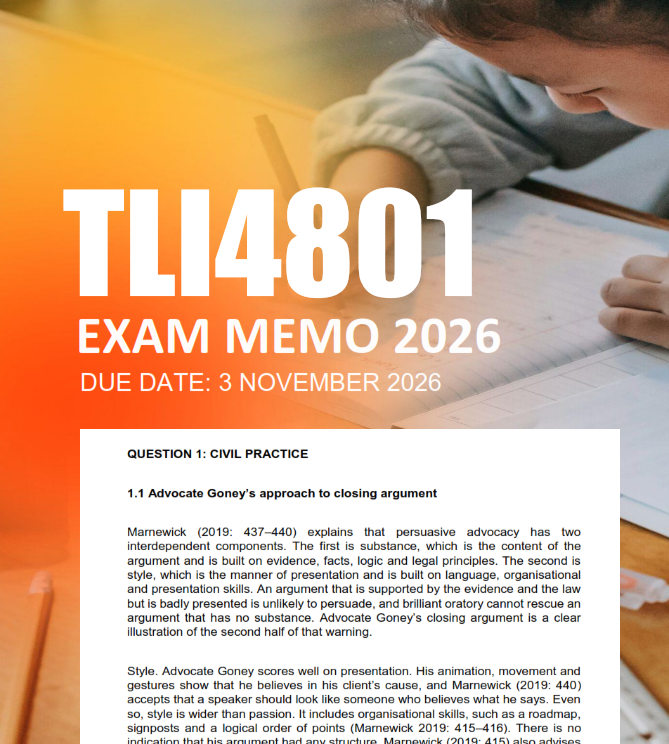
Description
1. The examination question paper comprises 10 pages. and counts 100 marks
2.
It consists of TWO (2) questions, namely Question 1 on Civil Practice and
Question 2 on Criminal Practice. Both questions are compulsory. Answer ALL
the questions.
3. The mymodules Unisa system will open for submission of your answers on 30
October 2026 at 08:00, and it will close on 03 November 2026
at 19h00. You may
submit your portfolio assessment answers at any time between these times, and you
may only submit during this period. At the expiry of this period, the system will close
and you will no longer be able to submit your answers. NO LATE OR EMAILED
SUBMISSIONS WILL BE ACCEPTED since this assessment counts as your
examination for this module.
2
TLI4801/202/2/2026
4. You are advised to submit your examination answers as soon as possible. NO
EXTENSION FOR LATE SUBMISSION WILL BE GRANTED TO STUDENTS WHO
FAIL TO SUBMIT THEIR EXAMINATION ANSWERS BY THE DUE DATE OF THE
EXAMINATION.
5. The cover page to your exam portfolio must include your name, student number, the
module code and the declaration of authenticity and accuracy. Ensure you keep a
copy of the portfolio that you submit AND keep evidence of your submission on the
mymodules platform. Also, FOLLOW ALL THE STEPS REQUIRED FOR
SUBMISSION. If you fail to do so, the system will show that you did not submit the
portfolio assignment, and your examination result will read “absent from
examination”.
6.
All queries regarding problems with mymodules must be addressed to the
Assignment Department or the ICT Department and not to the lecturers. We
cannot provide any technical assistance and do not have access to the system.
7.
It is preferred that your exam portfolio is typed, however, handwritten submissions
will also be accepted. If the portfolio exam is typed, the maximum length is 25 pages
(which includes the cover page and the bibliography). If the portfolio exam is
handwritten, the maximum length is 30 pages (which includes the cover page and the
bibliography).
8. Whether your answers are typed or handwritten, your submission on my Unisa
platform must be made in the form of one PDF document. You must submit your
examination answers as a single document in PDF-format and may not be submitted
with security restrictions under the “protect document”-option. Security restrictions
interfere with the electronic marking programme used and prevent the electronic
marking of assignments. Portfolios e-mailed to lecturers WILL NOT BE ACCEPTED
as assignments must be registered and processed on the system by the Assignment
Department. If you submit your portfolio in an incorrect format, or if you submit the
portfolio with security restrictions under the “protect document”-option, the portfolio
will simply be cancelled and you could fail this assessment (which will result in you
having to register for this module again next semester). As you may only submit one
document, you must ensure that everything you want us to assess is included in the
ONE document that you submit. No additional files will be accepted either on
mymodules or via e-mail. This includes the declaration of authenticity and accuracy!
A second submission automatically replaces the first submission on the system, and
a submission comprising only a declaration of authenticity and accuracy will thus
result in a zero-mark.
9.
If your answers are typed, ensure that the following requirements are adhered to.
Items 9.1-9.7 applies to written assignments as well.
9.1 The text must be typed in Arial font, size 12 with single line spacing within the
paragraph, and double line spacing after the paragraph.
9.2 The text must be justified.
9.3 All of the pages must be numbered in the bottom right-hand corner of the page.
3
TLI4801/202/2/2026
9.4 All margins must be 2.5cm, but the left margin must be 3cm.
9.5. South African English and not American English should be used. For example, the
correct spelling is “Labour” and not “Labor”.
9.6 Also do not use abbreviations or SMS language.
9.7 All quotes that are two lines long (or less), must form part of the main text, be written
in italics, and be bracketed by quotation marks. Where a quotation is longer than two
lines, it must be typed in a separate paragraph in italics in size 11 font and must be
indented by 1 cm. No quotation marks are required when the quotations stand alone.
Use quotations very sparingly. In this exam portfolio, a maximum of 5% of the text
may be quoted.
10. When answering the exam portfolio questions, remember that it is an open-book
exam which is a test at a higher level than the usual type of exam, where memory is
tested as much as insight. In an open-book exam, you need not memorise any
information. You are expected to prove that you can use information, rather than
merely repeat it. In brief, what is being tested is factual knowledge, understanding
and the correct application thereof, not memory skills. For this reason, you do not
earn marks by merely detailing a list of all the information that you think might be
relevant to a question. This gives no indication that you know what statutory or other
provisions are applicable in a specific context. You are expected to identify precisely
what information applies, and then explain why you think so. Also, because you have
the prescribed material available when answering questions, we do not give marks
for direct quotations from the prescribed material. You are therefore assessed on
your level of understanding of the legal principles by looking at how well you applied
the principles to the questions.
11. PLEASE DO NOT CUT AND PASTE ANSWERS FROM THE PRESCRIBED
SOURCES (OR ANY OTHER SOURCE).
12. The arguments that you make must be logical, well-structured and substantiated by
all of the relevant legal principles. You are given 4 days or 96 hours to complete the
portfolio exam. Use the time given wisely.
12.1 Ensure that you give reasons for each answer. Substantiate your answers by
referring to ALL of the relevant authorities, e.g. sections from relevant legislation
and/or court cases in the text or in your footnotes. Your answers must contain
complete references to sections in legislation, principles and relevant case law.
Students will be penalised for incomplete or incorrect references. Number your
answers correctly and write your answers in your own words. Students will
lose marks if their answers indicate copying, plagiarism or collaboration with
other parties. Student scripts may also be investigated for possible disciplinary
proceedings in these circumstances.
12.2 You are required to have read and summarised the prescribed material or sources
yourself. When using case law to support your answer, please include complete
references to the relevant cases in your footnotes. This means that you must not only
include the name of the case but also the exact page and section and/or paragraph
where the information can be found. The same applies to articles and books used.
4
TLI4801/202/2/2026
12.3 A number of students lose marks because they do not approach problem-type
questions correctly. When answering such questions, it is important to first clarify for
yourself the area of work where the answer must be sought. Once you have done
this, set out the relevant legal principles. Deal only with those principles that relate to
the given facts. Next, apply these principles to the facts. This is where most of the
students lose marks – they set out the law in some detail, but then do not illustrate
how it applies to the factual situation they have been asked to solve. Finally, state
your conclusion.
13 Please ensure that you complete and sign the DECLARATION OF AUTHENTICITY
AND ACCURACY at the end of this tutorial letter and attach the signed declaration
to your examination answers. You may retype the declaration, or you may attach the
signed declaration to your answers in any other manner. EXAMINATION ANSWERS
WITHOUT SIGNED DECLARATIONS WILL NOT BE MARKED.
14. Please ensure that you submit the correct assignment/assessment – a wrong
assignment/assessment will result in the cancellation of your assignment. If the
correct assignment is not resubmitted before the due date, a zero-mark will be
awarded.
5
TLI4801/202/2/2026
3. OCTOBER 2026 EXAMINATION QUESTION PAPER
QUESTION 1: CIVIL PRACTICE
1.1 Advocate Speedy Goney is representing a plaintiff in personal injury claim arising from
a slip and fall accident involving his elderly client that was injured whilst at the local
Supermarkert to buy bread and milk. The Advocate delivers a highly animated and
passionate speech, pacing around the courtroom and using dramatic hand gestures to
highlight the plaintiff’s suffering. However, because he ran out of preparation time, his
argument fails to explicitly cross-reference the conflicting expert witness testimonies
regarding the type of flooring where the incident took place and whether same can result
in one slipping and falling and suffering the extent of the physical injuries of the Plaintiff
nor does he address the possible defence raised by the Defendant e relating to the
signage board that the defendant claims was placed in the bread aisle warning people
of the floor being wet at the time that his client fell and sustained his injuries.
Critically evaluate Advocate Gooney’s approach to closing argument. In your
answer, contrast the “substance” and “style” of his advocacy and explain the
likely outcome of the case due to his failure to address the two critical issues
raised relating to the expert witness’ testimony and the defence raised by the
Defendant. Refer to Chapter 23 of the prescribed textbook in providing your
answers (10)
1.2 On 01 March 2026, Ms Dew Mac as the client retained the services of a Labour Law
litigation attorney, Ms. Cleverly Laws, practicing under the name and style of Laws Inc.
in Durban. The mandate was to represent her in an urgent application to challenge her
suspension from her executive role as the Managing Director of a Property Management
company based in Ballito. A written fee agreement was signed, stipulating that fees
would be charged R4,500 per hour, payable within 30 days of invoice.
Laws Inc. fully executed the mandate and rendered a final, fully itemised attorney-andclient
tax
invoice
on
10
April
2026
for
a
full
amount
of
R345,000.00.
Despite
numerous
demands
and
a
formal
notice
in
terms
of
the
fee
agreement,
Ms
Mac
failed,
neglected,
or
refused
to
settle
the
outstanding
balance.
On
1
June
2026,
Laws
Inc.
acting
as
the
Plaintiff
now
seeks
to
institute
legal
action
to
recover
the
amount it
is
owed
by Ms.
Mac
plus
interest
and
costs
6
TLI4801/202/2/2026
1.2.1 Briefly discuss the type of court proceedings that will be used to institute Laws Inc’s
claim.
(4)
1.2.2 Nane and discuss the legal elements (facta probanda) that will form part of the claim
by Laws Inc. based on the facts presented. NB: only name and discuss. Do not
draft any pleadings. (6)
1.2.3 Assume that Ms. Mac, due for reasons that she claims relates to financial distress,
had completely ignored the summons and did not enter an appearance to defend.
Discuss what steps Laws Inc. can take against Ms. Mac to ensure that the
matter can arrive at a speedy resolution.
(2)
1.2.4 Assume also that following the action taken by Laws inc. above, a writ of execution
is issued and subsequently served by a Sheriff at Ms. Mac’s home to attach her
movable assets but unbeknown to the Sheriff, Ms Mac shares the home with a tenant,
Ms. Unlucky Charm as the 3
rd
party. Consequently, the Sheriff attached an expensive
LG LED TV, and a leather lounge suite. Ms Charm had purchased these items
exclusively with her own funds three months prior and claims to possess original retail
receipts proving ownership. Ms. Charm is now approaching you for legal advice.
(a) Advise Ms. Charm on her rights and the specific procedural remedies available
under the Uniform Rules of Court to reclaim her assets and to stop their possible
removal and sale by the Sheriff. (4)
(b) Please indicate in terms of the High Court Uniform rules, the document that Ms.
Charm must submit as part of her bid to reclaim her assets and to stop their
possible removal and sale by the Sheriff AND draft the document that indicates
the particulars of this claim in accordance with the High Court Uniform Rules. (8)
(c) It now appears that the Lounge suite attached by the Sheriff was in fact bought
by Ms. Charm from Ms. Mac with the verbal agreement that she will pay for it in 3
monthly instalments but it so happened that at the time that the Sheriff attached it
there was only one payment outstanding but Ms. Charm had not disclosed this to
you when you filed her particulars of her claim. Discuss the ethical
responsibilities that you as the legal practitioner have in terms of the Legal
Practice Act, 2014 Code of Conduct, when you advise Ms Charm on how to
deal with these facts at the hearing of the matter.
(6)
1.3 Distinguish between the terms “advocacy” and “opinion” . (4)
1.4 Critically discuss whether “doing nothing” is an effective Alternative Dispute Resolution
strategy. (6)
[50]
7
TLI4801/202/2/2026
QUESTION 2: CRIMINAL PRACTICE
2.1 As a passionate human rights activist and a seasoned criminal law lawyer, you are
often involved in criminal litigation where your clients have, allegedly, been wrongly
accused of having committed crimes. Briefly discuss whether you, as a legal
representative, may fabricate a defence for your client. (4)
2.2 Being a seasoned criminal litigator, junior counsel requests you to enlighten them on
the different techniques that trial lawyers may use to improve the retention of key
information presented at the trial. Write an informative letter to your junior counsel in
this regard. (12)
2.2 You overhear your junior counsel arguing about whether a trial court is obliged to grant
a section 174 discharge at the end of the State’s case under certain circumstances or
whether the court still has discretionary power to do so. Fully explain to them the court’s
role on this point. (10)
2.4 Your second last client for the day is Mr. Steroid, a well-built but aggressive body
builder. Mr. Steroid is sweating profusely and nervously conveys to you that he is
charged with assault after his wife has reported an incident of domestic violence to the
police but that he is not guilty. Unfortunately for Mr. Steroid, evidence against him was
captured by their home’s security cameras. Their home address is 107 Violence Street,
Durban. Video footage clearly shows how Mr. Steroid hits his wife with his fists and
pulls her by the hair. Mr. Steroid persistently denies that he assaulted his wife or that
he acted unlawfully and intentionally. He instructs you to tender a plea of not guilty on
his behalf.
What would the implications be of not drafting a not guilty plea in terms of the Criminal
Procedure Act 51 of 1977 as instructed by Mr. Steroid?
(4)
2.5 Draft Mr. Steroid’s plea of not guilty in terms of the Criminal Procedure Act 51 of 1977.
In your answer, you are required to make up facts to supplement the given facts of the
case insofar as your own rendition does not detract from the core issues.
(10)
2.6 Your last clients for the day are three indignant and outraged LLB graduands, Sheraaz,
Peter and Basil. They relay to you that they were driving home from campus the
previous afternoon after a graduation ceremony where they were both awarded an LLB
degree in Criminal and Procedural law with distinction. To celebrate this momentous
occasion, the met up with friends in a public park where they smoked cannabis (dagga)
and enjoyed a glass of champagne. While the celebrations were in full swing, police
officials suddenly appeared and apprehended them. Upon searching them, the police
officials found a substantial amount of cannabis in their possession and arrested them
on the spot.
8
TLI4801/202/2/2026
While Sheraaz and Peter step out of your office to use the bathroom, Basil informs you
that he was initially approached by one of his co-accused, Peter, with an elaborate plan
to buy and use cannabis in public. All the accused engaged in this conduct well knowing
that their actions were unlawful and constituted crimes. Basil acknowledges that, even
though he committed some of these acts, he was merely acting on the instructions of
Peter. Basil is prepared to provide testimony on behalf of the State against Sheraaz
and Peter. Basil wants to know from you whether he can proceed with providing
evidence on behalf of the State in terms of section 204 of the Criminal Procedure Act
51 of 1977 and the implications of doing so. Fully explain to Basil whether he can
proceed with providing evidence on behalf of the State in terms of section 204, the
implications of doing so, as well as the purpose of section 204.
(10)
[50]
TOTAL: 100 MARKS
4. DECLARATION OF AUTHENTICITY AND ACCURACY
We enclose a sample declaration for completion. Please attach the signed declaration to
your examination answers. We will not mark your examination UNLESS you attach the
9
10



Reviews
There are no reviews yet.