
Description
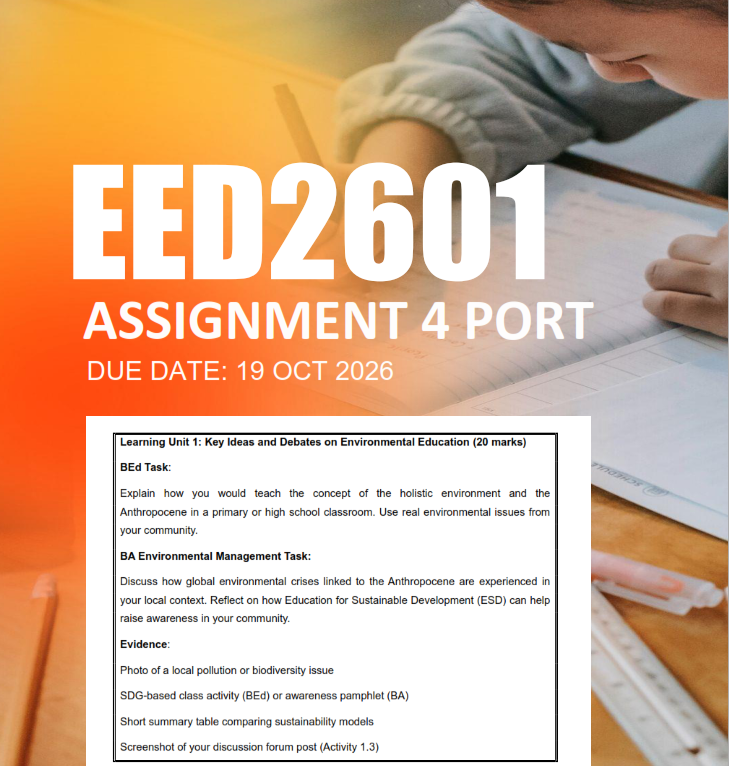
EED2601 Assignment 4 Semester 2 2026 – Due 19 October 2026
DEPARTMENT OF SCIENCE AND TECHNOLOGY EDUCATION
2026
EED2601
Environmental Education
ASSESSMENT 04 PORTFOLIO
ASSESSMENT DUE DATE: 19 October 2026
ASSESSMENT TOTAL MARKS: 100
HONESTY DECLARATION
Your exam script will not be marked if this is not completed.
I, ………………………………………………………………….
(Name & surname)
Student number: ……………………………………………….
Module code: …………………………………………………..
Hereby declare the following:
I understand Unisa’s policy on plagiarism. This examination is my original work produced
by myself. I have duly acknowledged all other people’s work (both electronic and print)
through the proper reference techniques as stipulated in this module.
I have not copied the work of any other person and handed it in as my own. I have also not
made my work available to any fellow students to submit as their own.
Signature: ………………………………. Date: ……………………….
2
EED2601/101
PURPOSE OF THE PORTFOLIO
This portfolio assesses your ability to apply environmental education principles in your
specific field of study. You are required to reflect on the content of Learning Units 1–5 and
demonstrate your understanding through real-world examples and evidence.
Please follow the task instructions according to your qualification stream:
1. BEd Students: Focus on how you would teach or apply these concepts in schools
or classrooms.
2. BA Environmental Management Students: Focus on environmental challenges
and community engagement in real-world or project-based contexts.
PORTFOLIO STRUCTURE
1. Cover Page (Student name, number, qualification, module code, title)
2. Table of Contents
3. Introduction: Briefly state your qualification stream and the local context you will be
using in the portfolio.
4. Learning Unit Sections (1–5) – include:
o Reflection (1–2 pages per unit)
o Supporting evidence (photos, plans, tables, etc.)
5. Conclusion: Reflect on how the module has influenced your thinking or practice.
6. References (APA 7 if academic sources are used)
7. Annexures: All supporting evidence
3
Learning Unit 1: Key Ideas and Debates on Environmental Education (20 marks)
BEd Task:
Explain how you would teach the concept of the holistic environment and the
Anthropocene in a primary or high school classroom. Use real environmental issues from
your community.
BA Environmental Management Task:
Discuss how global environmental crises linked to the Anthropocene are experienced in
your local context. Reflect on how Education for Sustainable Development (ESD) can help
raise awareness in your community.
Evidence:
Photo of a local pollution or biodiversity issue
SDG-based class activity (BEd) or awareness pamphlet (BA)
Short summary table comparing sustainability models
Screenshot of your discussion forum post (Activity 1.3)
Learning Unit 2: Learner and Learning Needs in EE (20 marks)
BEd Task:
Describe how you would accommodate diverse learning styles and multiple intelligences
when teaching an environmental concept.
BA Environmental Management Task:
Discuss how learning and engagement strategies should be adapted for different
community groups (for example, youth, farmers, elderly) in environmental education
campaigns.
Evidence:
Lesson plan, learning activity or teaching aid (BEd)
4
EED2601/101
Workshop outline or visual/public message (BA)
Infographic showing different learning preferences
Learning Unit 3: Historical and Contextual Aspects in EE (20 marks)
BEd Task:
Choose a local historical environmental issue (For example, water scarcity, alien plants)
and explain how you would teach its relevance to today’s learners.
BA Environmental Management Task:
Analyse a local environmental challenge and link it to past land use or policy trends. How
does historical context inform solutions?
Evidence:
Local map or photo
Lesson activity or worksheet (BEd)
Environmental report, project plan, or timeline (BA)
Learning Unit 4: Strategies for Environmental Education (20 marks)
BEd Task:
Explain how you would use three strategies (For example, problem-solving, critical
thinking, experiential learning) to teach environmental education in a school setting.
BA Environmental Management Task:
Describe how these same strategies could be used in a community environmental
awareness or behaviour change programme.
Evidence:
Completed reflection on a lesson or workshop
5
Photos/screenshots of active learning or field-based activity
Sample group task or role-play outline
Learning Unit 5: Indigenous Knowledge and Innovation in EE (20 marks)
BEd Task:
Identify an Indigenous Knowledge System (IKS) practice from your community and design a
classroom activity around it.
BA Environmental Management Task:
Discuss how IKS can contribute to sustainable community development or resource
conservation in your area.
Evidence:
Photo of an indigenous plant, tool, or sacred site
Lesson plan (BEd) or proposal outline (BA)
Transcribed quote or interview from an elder or knowledge holder
GRAND TOTAL: 100
©
UNISA 2026
6




Reviews
There are no reviews yet.