
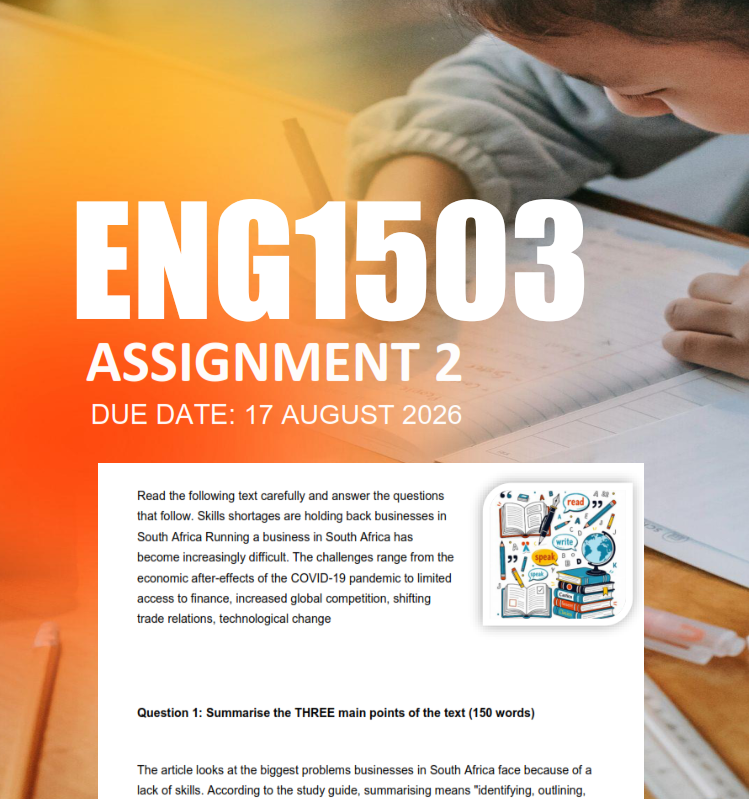
Description
GROUP ASSIGNMENT: 1 – Short paragraph questions
Unique number: 185373
Compulsory: Yes
Due date: 17 August 2026
Purpose: The purpose of this assignment is to teach you how to critically read an article,
engage with it, and reflect on it in an academic manner by responding to the assigned questions
in short, well-structured paragraphs. In addition, the assignment is designed to assess your
ability to think critically, analyse content, and express your ideas clearly in writing. When
marking the assignment, we will penalise poor language and faulty expression. Examples of
poor language expression include errors in sentence structure, incomprehensible and barely
literate vocabulary, spelling, punctuation, and so on.
Instructions
Read the text below and answer the following questions in short, coherent paragraphs of 150
words. Your answers should be written in full sentences and in continuous prose format. Do
not use bullet points. Unless explicitly instructed, avoid quoting directly from the text and
paraphrase ideas in your own words to demonstrate understanding. Please note: The use of
generative artificial intelligence (GenAI) tools to produce responses is strictly prohibited. Any
student found to have used such tools will face penalties in accordance with the institution’s
academic integrity policy.
Group requirements
– The group should have five (5) members.
– Each member is responsible for completing one (1) question.
– Each member should review and edit another member’s section.
– Discuss your answers as a group to ensure consistency, accuracy, and quality.
– Compile all five answers into one PDF document in the correct order (Questions 1 –
5).
– Review the whole document as a group and ensure there are no errors.
– Only one member should upload the assignment on behalf of the group.
Read the following text carefully and answer the questions that follow.
Skills shortages are holding back businesses in South Africa
Running a business in South Africa has become increasingly difficult. The challenges
range from the economic after-effects of the COVID-19 pandemic to limited access to
finance, increased global competition, shifting trade relations, technological change
and governance issues. As researchers with an interest in urban economies, we set out
to understand the biggest challenges facing businesses wanting to grow in South
Africa’s Western Cape province. The study involved surveying 426 businesses to draw
on the views of employers directly. Our findings show that their biggest constraints were
shortages in digital, soft, and environmental sustainability skills. The gaps were the
result of weaknesses in education and vocational training. These findings align with
problems in the broader South African labour market, like poor schooling, limited
practical skills and a mismatch between what people learn and what employers actually
need. Skills shortages affect not only job seekers but also business productivity, growth
and competitiveness. Yet most firms in our study reported spending only 1%-4% of their
wage bill on staff training. We argue that educational and training institutions play a key
role in developing skills, but businesses also have a responsibility to train and develop
their employees.
Business challenged by lack of skills
This study gathered the views of 426 business owners and senior managers based on
how various factors affected their operations. Those factors included institutions,
infrastructure, labour markets, skills, product markets and the natural environment.
Skills shortages emerged as the leading challenge facing businesses in the Western
Cape. More than 70% of respondents said they struggled to find workers with the right
skills. Many believed schools and vocational colleges were not adequately preparing




Reviews
There are no reviews yet.