Description

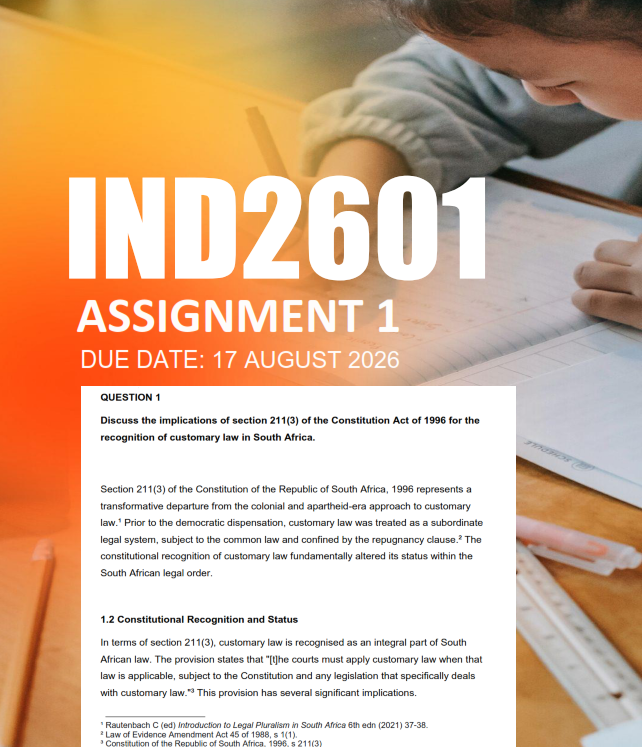
IND2601 ASSIGNMENT 1 2026
DUE 17 AUGUST 2026

QUESTION 1
Discuss the implications of section 211(3) of the Constitution Act of 1996 for the
recognition of customary law in South Africa.

Section 211(3) of the Constitution of the Republic of South Africa, 1996 represents a
transformative departure from the colonial and apartheid-era approach to customary
law.¹ Prior to the democratic dispensation, customary law was treated as a subordinate
legal system, subject to the common law and confined by the repugnancy clause.² The
constitutional recognition of customary law fundamentally altered its status within the
South African legal order.

1.2 Constitutional Recognition and Status
In terms of section 211(3), customary law is recognised as an integral part of South
African law. The provision states that “[t]he courts must apply customary law when that
law is applicable, subject to the Constitution and any legislation that specifically deals
with customary law.”³ This provision has several significant implications.

¹ Rautenbach C (ed) Introduction to Legal Pluralism in South Africa 6th edn (2021) 37-38.
² Law of Evidence Amendment Act 45 of 1988, s 1(1).
³ Constitution of the Republic of South Africa, 1996, s 211(3)

Reviews

There are no reviews yet.

Be the first to review “IND2601 Assignment 1 Semester 2 2026 – Due 17 August 2026”

Your email address will not be published. Required fields are marked *

Description

IND2601 ASSIGNMENT 1 2026
DUE 17 AUGUST 2026

QUESTION 1
Discuss the implications of section 211(3) of the Constitution Act of 1996 for the
recognition of customary law in South Africa.

Section 211(3) of the Constitution of the Republic of South Africa, 1996 represents a
transformative departure from the colonial and apartheid-era approach to customary
law.¹ Prior to the democratic dispensation, customary law was treated as a subordinate
legal system, subject to the common law and confined by the repugnancy clause.² The
constitutional recognition of customary law fundamentally altered its status within the
South African legal order.

1.2 Constitutional Recognition and Status
In terms of section 211(3), customary law is recognised as an integral part of South
African law. The provision states that “[t]he courts must apply customary law when that
law is applicable, subject to the Constitution and any legislation that specifically deals
with customary law.”³ This provision has several significant implications.

¹ Rautenbach C (ed) Introduction to Legal Pluralism in South Africa 6th edn (2021) 37-38.
² Law of Evidence Amendment Act 45 of 1988, s 1(1).
³ Constitution of the Republic of South Africa, 1996, s 211(3)

Reviews

There are no reviews yet.

Be the first to review “IND2601 Assignment 1 Semester 2 2026 – Due 17 August 2026”

Your email address will not be published. Required fields are marked *

About this IND2601 resource

This downloadable Assignment Study Resource is listed for the UNISA module IND2601. Review the document title, description, seller information, price and learner reviews before purchasing to make sure it matches your current module requirements.

StudyPass helps distance-learning students search by module code and discover notes, revision material and study resources shared by independent sellers. Always compare the resource details with your latest official UNISA tutorial letters and assessment instructions.

Search for another UNISA module code or visit the UNISA Study Hub for practical distance-learning and exam-preparation tips.

0
    0
    Your Shopping Cart
    Your cart is emptyReturn to Shop